

Best Budget Putters of 2026
This guide dives deep into the world of budget-friendly putters, proving that exceptional feel, alignment, and forgiveness are accessible to everyone. We’ve meticulously researched and reviewed the top contenders that offer remarkable value without compromising on the essential features needed to shave strokes off your game. Get ready to discover a putter that not only fits your budget but also elevates your confidence on the green, turning three-putts into distant memories.
1. PGM Golf Blade Putter for Men & Women

- Design: Notched groove strike surface for precision
- Weight & Length: 34-inch length, 350g head, 113g shaft
- Forgiveness: High fault tolerance minimizes off-center errors
- Face: Milled face for optimal contact and durability
The PGM Golf Blade Putter stands out as an excellent choice for golfers seeking enhanced precision and forgiveness without a premium price tag. Its unique notched groove design on the strike surface significantly improves the interaction between the club and the ball. This attention to detail in the face design is crucial for players looking to fine-tune their putting game. With a perfectly balanced 34-inch length, featuring a 113g shaft and a 350g head, this putter caters to both male and female golfers.
The putter’s high fault tolerance is a game-changer for those struggling with off-center hits, effectively minimizing the impact of mishits and helping golfers maintain a consistent line. Complementing this is the straight tapered design and classic blade shape, which provides superior visual alignment. Furthermore, the durable club head, crafted with a milled face, ensures optimal contact and a smooth roll. This blend of precision, forgiveness, and robust construction makes the PGM Golf Putter a compelling budget-friendly option, ideal for anyone aiming to lower their handicap and enjoy more consistent putting.
- Pros:
- Enhances putting precision with notched groove design
- High forgiveness for off-center hits
- Excellent alignment aids with straight tapered design
- Cons:
- Blade design may offer less forgiveness than mallets for some
- Only available in right-handed
2. Orlimar Golf Tangent T1 Mallet Putter

- Design: High MOI for added forgiveness
- Hosel: Plumber’s neck offset for ideal hand position
- Face: Soft TPU face insert for enhanced feel
- Alignment: Contrasting bi-color sightline for accuracy
The Orlimar Golf Tangent T1 Mallet Putter is a standout choice for golfers prioritizing forgiveness and feel on the greens, all within a budget-friendly price point. Its High MOI (Moment of Inertia) design is engineered to resist twisting on off-center hits, leading to more consistent ball speed and direction across the entire putter face. This feature is particularly beneficial for golfers who struggle with consistency, as it helps to minimize the impact of slight imperfections in their stroke.
Feel is paramount in putting, and the Tangent T1 delivers with a soft TPU face insert. This insert provides a gentle, responsive feel upon impact, allowing for better distance control and feedback, which is crucial for mastering different putts. Coupled with the contrasting bi-color sightline, this putter greatly enhances alignment, making it easier to square up to the target and build confidence before each stroke. The inclusion of a free headcover adds excellent value.
- Pros:
- High MOI design offers significant forgiveness
- Soft TPU insert provides excellent feel and feedback
- Bi-color sightline improves alignment accuracy
- Cons:
- Mallet design may not appeal to all traditionalists
- Specific neck hosel might require adjustment for some golfers
3. THIODOON Two-Way Adjustable Golf Putter

- Design: Timeless two-way cast iron head
- Adjustability: Shaft length adjustable from 21-37 inches
- Material: High-quality aluminum alloy shaft, rubber grip
- Portability: Lightweight (approx. 0.75LB) and compact
The THIODOON Two-Way Adjustable Golf Putter is an incredibly versatile and family-friendly option, perfect for golfers of all ages and skill levels, regardless of their dominant hand. Its classic two-way cast iron head design ensures that it can be used effectively by both right-handed and left-handed players, making it an ideal choice for households with multiple golfers or for introducing newcomers to the game. This universal usability is a significant advantage, eliminating the need for multiple putters and simplifying practice sessions.
Crafted with a high-quality aluminum alloy shaft, the THIODOON putter offers impressive durability and a solid feel, capable of withstanding regular use both indoors and outdoors. The scientifically designed non-slip rubber grip further enhances comfort and control, promoting a stable and confident stroke. Its lightweight and portable nature (weighing just about 0.75LB) allows for effortless storage and transport, fitting easily into a golf bag or even a backpack.
- Pros:
- Two-way design suits both right and left-handed golfers
- Adjustable length accommodates all ages (children to adults)
- Durable construction with high-quality materials
- Cons:
- Basic design lacks advanced alignment aids of specialized putters
- Feel might not be as refined as premium models
4. Wilson Harmonized X5 Mallet Putter

- Type: Large mallet head for stability
- Hand Orientation: Right-handed specific design
- Length: 33-inch shaft for a compact setup
- Grip: Standard grip for traditional feel
The Wilson Harmonized X5 Mallet Putter is an excellent entry-level option for right-handed golfers seeking improved stability and forgiveness on the green without a hefty price tag. Its large mallet head design is engineered to boost the Moment of Inertia (MOI), which effectively reduces twisting on off-center putts. This means that even if you don’t strike the ball perfectly in the center of the face, the putter maintains its line and delivers a more consistent roll.
At a 33-inch length, this putter is well-suited for golfers who prefer a slightly shorter shaft, promoting a more upright stance and potentially aiding in eye-over-ball positioning for better alignment. The standard grip offers a familiar and comfortable feel for most players, encouraging consistent hand placement and a natural stroke. While it maintains a straightforward design, the Harmonized X5 focuses on delivering fundamental performance where it matters most: stability, forgiveness, and a consistent roll.
- Pros:
- Large mallet head offers high forgiveness and stability
- Standard grip provides a familiar and comfortable feel
- 33-inch length suits specific stance preferences
- Cons:
- Only available in right-handed orientation
- Lacks advanced alignment aids found on premium putters
5. GoSports Classic Two-Way Golf Putter
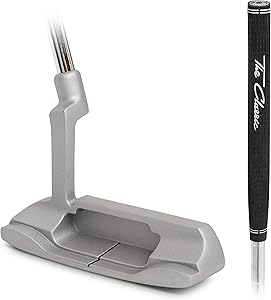
- Design: Timeless two-way cast iron head
- Length: Traditional 35-inch shaft for adults
- Grip: Ambidextrous rubberized comfort grip
- Versatility: Ideal for practice, mini golf, and casual play
The GoSports Classic Two-Way Golf Putter embodies timeless design and remarkable versatility. Its two-way cast iron head is crafted in the enduring style of classic putters, ensuring a true roll on putts regardless of whether you’re right-handed or left-handed. This ambidextrous design is a significant advantage, allowing multiple users to share one club or providing flexibility for players experimenting with their putting style. The traditional 35-inch shaft is an adult size.
Comfort and stability are key, and this putter delivers with a premium rubberized grip. Engineered for ambidextrous use, the grip provides excellent comfort and enhances stability throughout your stroke, contributing to more consistent putts. Beyond its ergonomic design, the GoSports Classic Putter excels in its adaptability. It’s perfect for simply picking up and playing, whether you’re practicing in your backyard, dominating the mini-golf course, enjoying putt-putt games in the office, or even using it for introductory golf lessons.
- Pros:
- Two-way design suits both right and left-handed players
- Timeless design ensures a true and consistent roll
- Comfortable ambidextrous rubberized grip
- Cons:
- Lacks advanced features of performance putters
- May not offer the refined feel for competitive golfers
6. MAZEL Tour GS Men’s Golf Putter

- Design: High MOI for speed control and forgiveness
- Alignment: Advanced top lines for precision aiming
- Material: 431 Stainless Steel with CNC Milled Face
- Grip: High-performance rubber grip for feel and absorption
The MAZEL Tour GS Men’s Golf Putter is a thoughtfully engineered club designed to help golfers improve their putting accuracy and consistency without a hefty investment. Its core strength lies in a high MOI (Moment of Inertia) design, which significantly enhances speed control across the putter face. This means that even on slight mishits, the ball maintains a more consistent speed and line, getting closer to the hole regardless of the quality of the strike. This forgiveness is crucial for golfers looking to shave strokes off their game and build confidence on the green.
The construction of the MAZEL Tour GS is impressive for its price point, utilizing 431 Stainless Steel with a CNC Milled Face. This combination not only provides excellent durability but also ensures optimal contact and a very consistent, smooth roll off the face, which is vital for distance control. The low center of gravity further promotes a more fluid and stable stroke, giving the putter a great feel upon impact. Rounding out its features is a high-performance rubber grip.
- Pros:
- High MOI design for superior speed control and forgiveness
- Advanced alignment top lines enhance aiming accuracy
- CNC milled stainless steel face provides excellent feel and roll
- Cons:
- Only available for right-handed golfers
- Specific design might not suit all aesthetic preferences
7. GoSports GS1 Tour Blade Putter

- Type: Right-handed blade putter
- Face: Stainless Steel head with milled face
- Grip Options: Choice of Oversized or Traditional Fat Grip (1.3-inch)
- Included: Padded headcover for protection
The GoSports GS1 Tour Blade Putter offers aspiring golfers and seasoned players alike a premium putting experience without the premium price tag. Designed for right-handed golfers of all abilities, this blade putter boasts a classic aesthetic combined with features typically found in much more expensive clubs. The putter’s stainless steel head, coupled with a precision-milled face, ensures optimal contact with the ball, promoting a smooth, consistent roll directly off the face. This milled face technology is a significant advantage. The overall look and feel of the GS1 Tour truly emulate high-end putters.
A standout feature of the GS1 Tour is the choice of grip, particularly the 1.3-inch diameter Fat Grip option. Oversized grips have gained immense popularity among professionals and amateurs alike because they minimize wrist rotation and promote a more consistent, pendulum-like stroke. This can lead to greater accuracy and stability, especially for those prone to wristy putts. For golfers who prefer a more traditional feel, a standard grip option is also available.
- Pros:
- Premium look and feel comparable to expensive putters
- Milled stainless steel face for optimal contact and roll
- Oversized Fat Grip option enhances stroke consistency
- Cons:
- Blade design may offer less forgiveness than mallets for some
- Only available for right-handed golfers
How to Choose Budget Putters
Putting is often dubbed the “game within the game” and for good reason. It accounts for roughly 40% of all strokes in a typical round, making it the fastest way to shave strokes off your scorecard. While many golfers splurge on drivers and irons, the putter often gets overlooked, mistakenly believed to require a hefty investment for performance. The truth is, you don’t need to break the bank to find a putter that perfectly complements your stroke and boosts your confidence on the green. Affordable putters have come a long way, offering advanced features, excellent feel, and superb forgiveness once reserved for premium models. This comprehensive guide will walk you through everything you need to know to choose the best budget putter that feels great in your hands and consistently drops putts.
Key Factors to Consider When Choosing a Budget Putter
Navigating the vast selection of putters can be daunting, but by focusing on a few key characteristics, you can narrow down your options and find the perfect fit. Even on a budget, paying attention to these factors will ensure you make an informed decision that truly enhances your game.
Putter Type: Blade, Mallet, or Mid-Mallet
The most immediate distinction among putters is their head shape, which significantly impacts feel, forgiveness, and alignment. Knowing your preference and stroke type will help you choose wisely.
- Blade Putters: These are the traditional, slender putters, typically preferred by golfers with an arcing putting stroke. They offer less forgiveness than mallets but provide excellent feel and feedback on mishits, allowing skilled players to control distance and direction with precision. Blade putters often have “toe hang,” meaning the toe points downwards when balanced on your finger, suiting an arcing stroke.
- Mallet Putters: Characterized by their larger, often geometric heads, mallet putters are designed for maximum forgiveness and stability. Their increased Moment of Inertia (MOI) helps resist twisting on off-center strikes, promoting a straighter ball roll. Mallets often feature extensive alignment aids, making them ideal for golfers with a straight-back-straight-through stroke or those who struggle with alignment. They are typically “face-balanced,” meaning the putter face points directly upwards when balanced, which complements a straight stroke.
- Mid-Mallet Putters: As the name suggests, mid-mallets bridge the gap between blades and full mallets. They offer a good balance of feel, forgiveness, and alignment, making them a versatile choice for a wide range of golfers. They might have a slight arc or face-balanced design depending on the specific model.
Putter Length
The length of your putter is crucial for maintaining proper posture and eye position over the ball. An incorrect length can lead to poor alignment, inconsistent contact, and discomfort. The most common lengths range from 33 to 35 inches. To find your ideal length, adopt your natural putting stance with your arms hanging comfortably. Have a friend measure the distance from the ground to the top of your grip. Your eyes should ideally be directly over or slightly inside the ball, allowing for a clear view of the target line. A putter that is too long will force you to stand too upright or choke down excessively, while one that is too short will make you crouch uncomfortably. Don’t be afraid to try different lengths to see what feels most natural and promotes a consistent setup.
Weight and Balance
The overall weight and balance of a putter profoundly influence your stroke rhythm and control. A heavier putter can help stabilize your stroke, especially on faster greens, and prevent quick, jerky movements. Lighter putters might offer more feel but require a smoother tempo. Many budget putters now incorporate perimeter weighting or internal weighting systems to enhance MOI and stability. Pay attention to the “swing weight” and “head weight” specifications. A higher head weight can provide a more solid feel and help you keep the putter on line. Some putters are also “counterbalanced,” meaning they have extra weight in the grip end to provide stability. Experiment with different weights to see what allows for a smooth, repeatable pendulum stroke.
Face Insert Material
The material of the putter face significantly impacts the feel, sound, and roll of the ball. Budget putters often feature polymer inserts, milled steel faces, or a combination. Polymer inserts typically offer a softer feel and sound, which many golfers prefer for touch and distance control, especially on fast greens. Milled steel faces, often found on more premium budget options, provide a firmer feel and a crisper sound, giving excellent feedback on impact and promoting a very consistent roll. While personal preference plays a huge role, a softer insert might be beneficial for beginners as it can be more forgiving. A firmer face might be preferred by those who like immediate feedback.
Alignment Aids
Effective alignment is paramount for consistent putting. Even a slight misalignment can send your ball off target. Modern putters, especially mallets, come with a variety of alignment aids, from simple single lines to multiple parallel lines, dots, or geometric shapes. These visual cues are designed to help you square the putter face to your target line and maintain a consistent setup. When evaluating budget putters, look for alignment aids that naturally draw your eye to the target and feel intuitive. What works for one golfer might not work for another, so consider what helps you visualize your line most effectively. Simple, bold lines often prove to be very effective without being distracting.
Grip Type
The grip is your primary connection to the putter, and its size, shape, and material can have a substantial impact on your stroke. Standard putter grips are common, but oversized or “fat” grips have become increasingly popular. Oversized grips can help minimize excessive wrist movement, promoting a more stable, pendulum-like stroke, and can be particularly beneficial for golfers who get too “handsy.” They also tend to reduce grip pressure, which can lead to a smoother swing. Conversely, a thinner grip might provide more feel and allow for more wrist action, which some advanced players prefer. Consider your hand size and putting style when choosing a grip. Many budget putters offer a decent standard grip, but some might allow for an aftermarket grip change if you have a strong preference.
Hand Orientation
This might seem obvious, but always ensure the putter matches your dominant hand for putting. Right-handed golfers use right-handed putters, and left-handed golfers use left-handed putters. While most putters are designed for right-handed players, the selection for left-handed options in the cheaper category is growing. Some novelty or practice putters might be “two-way,” meaning they can be used by either hand, which is great for casual play or teaching but typically lacks the specific design nuances for optimal performance in competitive rounds.
Testing and Feel
Even when buying on a budget, the “feel” of a putter is paramount. Ideally, you should try out a few different inexpensive putters before making a purchase. If you can’t test them on a real green, an indoor putting mat or even a carpeted floor can give you a basic idea of the balance, weight, and feel. Does the putter feel balanced in your hands? Does it promote a smooth stroke? Does the ball come off the face with the desired speed and sound? The subjective feel of a putter is incredibly personal, and what feels great to one golfer might feel awkward to another. Pay attention to how the putter impacts your natural stroke and whether it instills confidence.
Understanding Your Stroke
Your natural putting stroke type should also guide your putter choice. Generally, there are three main stroke types: straight back and straight through, slight arc, and strong arc. Putters are designed with different amounts of “toe hang” (how much the toe of the putter points down when balanced) to match these strokes. Face-balanced putters (toe points up) are generally best for straight strokes, while putters with more toe hang are suited for arcing strokes. Knowing your stroke type can help you pick a putter that works with your natural motion, rather than fighting against it, leading to more consistent results.
Setting a Budget and Where to Buy
When searching for the cheapest putter, expect to find excellent options in the $50-$150 range. At this price point, you can still get putters with milled faces, high MOI designs, and effective alignment aids. Online retailers like Amazon often have the widest selection and competitive pricing, but don’t overlook sporting goods stores for potential deals or the opportunity to hold the putters in person. Reading reviews from other golfers can also provide valuable insights into real-world performance.
Conclusion
Choosing the best cheap putter doesn’t mean settling for subpar performance. By understanding your own putting stroke and considering key factors like putter type, length, weight, face material, and alignment aids, you can find a high-performing putter that truly enhances your game. Take the time to research, prioritize features that matter most to you, and, if possible, test a few options.