

Best 12v Solar Battery Chargers of 2026
Looking for a simple way to keep your car, boat, or RV battery topped up with power from the sun? A 12v solar battery charger is the perfect eco-friendly solution. These handy devices use sunlight to prevent dead batteries, are incredibly easy to set up, and require no fuel or mains electricity. In this guide, we have reviewed the best options to help you choose the perfect model.
1. SUNER POWER Solar Battery Charger

- Technology: Ultra-Smart MPPT with 99% tracking efficiency
- Charging Stages: Improved 3-stage algorithm (Bulk, Absorption, Float)
- Compatibility: 12V Lead-Acid, AGM, Gel, SLA, and LiFePO4 batteries
- Protection: Full safety suite including over-charge and reverse polarity
The SUNER POWER Solar Battery Charger stands out due to its integration of advanced MPPT technology, which significantly outpaces standard controllers by capturing up to 30% more energy. This efficiency ensures that even smaller panels can effectively maintain a charge on larger 12V systems. The smart 3-stage charging cycle is a highlight, as it transitionally manages the current to prevent overheating and bubbling, ultimately extending the chemical life of your expensive deep-cycle or lithium batteries.
The build quality is impressive, featuring Grade A+ solar cells protected by tempered glass and a corrosion-resistant frame. This makes it a reliable “set and forget” solution for seasonal vehicles like RVs or boats. Since it stops and resumes charging automatically based on the battery’s real-time discharge, it requires zero manual intervention. The plug-and-play cables and included suction cups make the initial setup incredibly straightforward for any user.
Pros: High 98% conversion efficiency; compatible with LiFePO4; rugged weatherproof construction.
Cons: Slightly higher price point than basic trickle chargers; suction cups may lose grip in extreme heat.
See the SUNER POWER Solar Battery Charger
2. POWOXI Charging Kit

- Efficiency: 25-30% energy conversion using quality silicon
- Frame Material: Durable ABS+PC scratch-protection design
- Safety: Built-in blocking diode and smart internal protection system
- Indicators: 2-color LED visual charging status (Red/Green)
The POWOXI Charging Kit is specifically engineered for durability and vehicle safety. Unlike traditional aluminum frames that might scratch car paint, its ABS+PC frame provides a rugged yet soft-touch exterior. The high-transparency, low-iron tempered glass ensures that the unit can withstand impact and harsh weather like wind or snow. It is an ideal maintainer for users who need a portable solution to prevent battery drain in motorcycles or farm equipment.
Functionality is centered around ease of use, offering two distinct connection methods: a cigarette lighter plug for interior dashboard placement or alligator clips for direct battery attachment. The simple two-color LED indicator provides immediate feedback, showing when the panel is receiving sunlight and when it is actively pushing current to the battery. It is a stable, low-maintenance choice for keeping 12V batteries topped off during long periods of inactivity.
Pros: Paint-safe frame design; impact-resistant glass; very simple LED status monitoring.
Cons: 7.5W output is strictly for maintenance, not for charging dead batteries; cigarette lighter port must be “always on” to work.
3. ECO-WORTHY Solar Charger

- Panel Type: 10W Monocrystalline with frosted surface
- Protection: Integrated PCB for reverse and overcharge prevention
- Installation: 3-minute setup with SAE plug-and-play cables
- Weatherproofing: Fully waterproof design for outdoor use
The ECO-WORTHY 10W Solar Charger is a reliable “battery savior” designed to eliminate the need for periodic vehicle starts during the off-season. Its monocrystalline cells are treated with a frosted surface, which removes the need for protective films while maintaining high efficiency even on cloudy days. The built-in blocking diode is a critical feature, ensuring that the battery does not discharge back through the panel at night, which is a common flaw in cheaper models.
This kit is particularly user-friendly, featuring an upgraded PCB that allows for accurate open-circuit voltage testing. Whether you are maintaining a lawnmower, a boat, or a trailer, the SAE connection system allows for a quick switch between the cigarette lighter adapter and alligator clips. It is a compact and efficient solution that provides peace of mind for travelers and homeowners who want to ensure their utility vehicles are always ready to start.
Pros: Works well in low-light conditions; very fast installation; reliable reverse-current protection.
Cons: Lacks detailed percentage indicators; mounting suction cups are better suited for interior glass than exterior surfaces.
See the ECO-WORTHY Solar Charger
4. Voltset 12V Solar Battery Charger

- Output: 20W high-efficiency A+ monocrystalline panel
- Durability: IP67 waterproof rating with marine-grade construction
- Display: Real-time LED status indicators (25% to 100%)
- Temp Range: Operates from -40°F to 185°F
The Voltset 12V Solar Battery Charger is a powerhouse in the trickle charger category, offering a 20W output that charges 20-30% faster than standard 10W competitors. This makes it suitable not just for maintenance, but for actively recovering batteries that have dipped in voltage. Its marine-grade construction and IP67 rating mean it can handle extreme environments, from freezing snow to blistering heat, making it perfect for off-grid gate openers and boat docks.
The intelligent controller is the brain of the operation, featuring an auto-stop function that prevents overcharging and an auto-resume feature that kicks in as soon as a voltage drop is detected. Unlike simpler models, the Voltset provides a clear 4-stage LED display so you can see exactly how much charge your battery has at a glance. It is a versatile, high-performance tool compatible with almost every 12V chemistry, including Lithium-Ion and AGM.
Pros: High 20W output; excellent IP67 weather resistance; clear battery percentage readout.
Cons: Larger footprint than 5W/10W models; may be overkill for very small motorcycle batteries.
See the Voltset 12V Solar Battery Charger
5. SOLPERK Solar Panel Kit

- Controller: Upgraded 8A smart 3-stage charger
- Mounting: 360-degree angle adjustable mounting bracket
- Resilience: Withstands 2400Pa wind and 5400Pa snow loads
- Lifespan: Rated for up to 25 years of outdoor use
The SOLPERK 20W Kit is a professional-grade solution for those who need a permanent solar installation. The standout feature is the included 360-degree adjustable mounting bracket, which allows users to tilt the panel toward the sun for maximum efficiency regardless of where it is mounted. Built with low-iron tempered glass and a corrosion-resistant aluminum frame, this panel is designed to survive heavy storms, hail, and extreme snow loads without losing performance.
The upgraded 8A controller is significantly more efficient than standard regulators, utilizing a 3-stage charging process that protects the battery from over-voltage and short circuits. Because the kit includes O-rings and alligator clips, it is equally suited for permanent mounting on a fence or temporary use on a trailer. The 25-year lifespan rating highlights the superior build quality, making it a sound long-term investment for maintaining gate openers, water pumps, or RV batteries.
Pros: Superior mounting flexibility; very high snow/wind load rating; long-term durability.
Cons: More assembly required due to the bracket; controller is external rather than built-in.
See the SOLPERK Solar Panel Kit
6. SUNER POWER Battery Charger (20W)

- Modes: Three selectable modes (12V, AGM, Lithium)
- Monitoring: Visual charge level indicators (25% to 100%)
- Efficiency: 99% MPPT tracking with 98% peak conversion
- Protection: Spark-proof and waterproof safety design
This 20W version of the SUNER POWER charger offers specialized control that many other maintainers lack. By allowing users to toggle between 12V, AGM, and Lithium modes, it optimizes the charging curve for the specific chemistry of your battery. This precision prevents the common issue of undercharging lithium batteries or over-gassing flooded ones. The MPPT technology remains best-in-class, ensuring that even in suboptimal light, your battery receives the maximum possible current.
The visual interface is highly informative, displaying the charging stage through clear increments. This takes the guesswork out of maintenance, as you can see exactly when the battery has reached 100%. The unit is fully automatic, meaning it will safely enter a float mode once the battery is full. With its spark-proof technology and robust waterproof housing, it provides a high level of safety for marine and automotive applications where moisture is a constant factor.
Pros: Dedicated mode switching; high-accuracy MPPT; clear percentage indicators.
Cons: More complex to operate than single-mode chargers; slightly heavier than the 10W version.
See the SUNER POWER Battery Charger (20W)
7. SUNAPEX 12V Solar Battery Charger
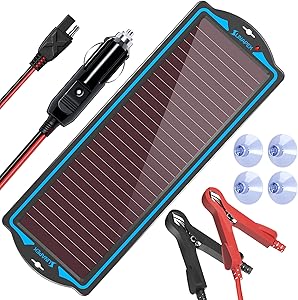
- Construction: High-strength PV glass with sturdy ABS frame
- Controller: Integrated auto-stop/resume functionality
- Portability: Lightweight design with suction cup mounting
- Stability: Consistent output even in cloudy conditions
The SUNAPEX 12V Solar Battery Charger is marketed as a “battery savior” for infrequently used vehicles. It excels in simplicity, featuring a built-in controller that prevents overcharging without the need for external boxes or complex wiring. Its ability to provide stable output during cloudy weather sets it apart from lower-quality panels that often shut down entirely when the sun is obscured. This makes it a reliable choice for regions with inconsistent weather patterns.
The rugged ABS frame and fully sealed waterproof design ensure the panel can live outdoors for a decade. It is particularly popular for car and boat owners who want to mount the panel on a window or dashboard using the included suction cups. The two-light LED system provides a “no-nonsense” status check: red for sunlight and green for active charging. It is a hassle-free, portable solution for keeping your engine ready to start at a moment’s notice.
Pros: Excellent performance in low light; very easy to move between vehicles; rugged sealed design.
Cons: 10-year lifespan is shorter than premium 25-year models; basic LED indicators lack detailed info.
See the SUNAPEX 12V Solar Battery Charger
8. OYMSAE Solar Trickle Charger

- Material: ETFE coating with 95% light transmittance
- Power: 30W high-output trickle charging mode
- Visualization: 3-color LED system for sun, charging, and full status
- Durability: CPB bottom plate to prevent panel breakage
The OYMSAE Solar Trickle Charger uses premium ETFE material, which allows for significantly better light transmittance than standard plastic coatings. This technology, combined with a 30W output, makes it one of the most powerful maintainers on the list, capable of supporting larger battery banks. The addition of a CPB bottom plate is a unique engineering choice that adds structural rigidity, greatly reducing the risk of micro-cracks and efficiency loss over time.
Monitoring is handled by a three-color LED system that provides specific feedback, including a warning if a short circuit occurs. The kit is highly versatile thanks to the three-piece SAE cable set, allowing for various connection types right out of the box. Whether you are maintaining a 12V battery for a truck, tractor, or off-grid cabin, the OYMSAE provides a high-efficiency, durable, and easy-to-use charging solution that handles the elements with ease.
Pros: Top-tier 30W output; ETFE coating for superior light capture; very rigid construction.
Cons: Larger size may be difficult to place on small dashboards; ETFE can be more expensive to replace.
See the OYMSAE Solar Trickle Charger
The Ultimate Guide to Choosing 12V Solar Battery Chargers
Harnessing the sun to keep your batteries topped up is one of the most liberating upgrades you can make for your outdoor or off-grid lifestyle. Whether you are maintaining a classic car in storage, powering a camper van, or keeping a boat’s bilge pump ready for action, a 12V solar battery charger is a silent, sustainable workhorse. However, the market is flooded with everything from $20 “trickle” panels to $500 sophisticated charging arrays. Choosing the right one requires a blend of understanding your energy needs and knowing the technical specifications of your battery setup.
Understanding the Basics of 12V Solar Charging
Before diving into product specs, it is vital to understand what a 12V solar charger actually does. Despite the name, a “12V” solar panel actually outputs between 16V and 22V. This higher voltage is necessary to “push” current into a 12V battery, which usually requires about 14.4V for a full charge.
A solar charging system typically consists of three main components:
- The Solar Panel: Converts sunlight into DC electricity.
- The Charge Controller: The “brain” that prevents overcharging and regulates voltage.
- The Battery: Your storage reservoir (Lead-acid, AGM, Gel, or Lithium).
Step 1: Determine Your Charging Goal
The first step in choosing a charger is defining what you want it to accomplish. Most users fall into one of two categories: maintenance or active charging.
Battery Maintenance (Trickle Charging)
If your goal is simply to counteract “parasitic drain” (the small amount of power used by clocks and alarms) or natural self-discharge while a vehicle is parked, you need a small maintenance charger. These are typically 5W to 20W panels. They are not designed to “recharge” a dead battery, but rather to keep a healthy one healthy.
Active Recovery and Powering Loads
If you are using lights, fridges, or fans and need to replenish that energy daily, you need an active charging setup. This usually requires 50W to 200W of solar power. To calculate your needs, you must estimate your daily Amp-hour (Ah) consumption. A good rule of thumb is that a 100W panel will provide roughly 30-40 Ah of charge per day in ideal sunny conditions.
Step 2: Choosing the Right Panel Type
Not all solar cells are created equal. The material used in the panel affects its footprint, lifespan, and performance in low-light conditions.
Monocrystalline Panels
These are made from a single crystal structure and are the most efficient. They take up the least amount of space for the power they produce and perform better in slightly overcast conditions. They are usually the best choice for permanent roof mounts on RVs or boats.
Polycrystalline Panels
Recognizable by their blue, speckled appearance, these are made from multiple silicon fragments. They are slightly less efficient than monocrystalline panels but are often more budget-friendly. If you have plenty of space (like a shed roof), “poly” panels offer the best watt-per-dollar value.
Thin-Film and Flexible Panels
These are lightweight and can be glued directly to curved surfaces. While convenient, they often have shorter lifespans than rigid glass panels and can be prone to overheating if there is no airflow beneath them.
Step 3: Selecting the Charge Controller
Unless you are using a very small maintenance panel (under 10W) on a very large battery, you must use a charge controller. Without it, the panel will continue to send voltage to the battery even when it is full, essentially “boiling” the electrolyte and destroying the cells.
PWM (Pulse Width Modulation)
PWM controllers are the older, simpler technology. They act like a rapid “on/off” switch to keep the battery at a set voltage. They are inexpensive and reliable but inefficient because they cannot convert excess voltage into extra current. They are best for small systems where cost is the primary concern.
MPPT (Maximum Power Point Tracking)
MPPT controllers are the gold standard. They use an algorithm to find the “sweet spot” where the panel produces the most power and then converts the excess voltage into additional amperage for the battery. They are 20-30% more efficient than PWM, especially in cold or cloudy weather. If you are buying a panel over 100W, an MPPT controller is almost always worth the extra investment.
[Image comparing PWM vs MPPT charging efficiency curves]
Step 4: Matching the Charger to Battery Chemistry
Your 12V solar charger must “speak the language” of your battery. Different batteries require different charging profiles (voltages at different stages of the charge cycle).
Lead-Acid (Flooded, AGM, and Gel)
Most basic chargers are designed for lead-acid. AGM and Gel batteries are more sensitive to overcharging, so ensure your controller has a specific setting for these types to avoid venting gasses and shortening their life.
Lithium Iron Phosphate (LiFePO4)
Lithium batteries are becoming the standard for off-grid use because they are light and can be discharged deeply. However, they require a very specific charging profile and usually do not require a “desulfation” or “equalization” stage, which can actually damage them. Ensure your solar controller is explicitly “Lithium Compatible.”
Step 5: Portability vs. Permanent Installation
How do you plan to use the charger? This dictates the physical form factor of the kit.
Suitcase and Foldable Kits
These are perfect for weekend campers. They come with integrated legs and a handle, allowing you to park your vehicle in the shade while placing the panels in the direct sun. They usually include a pre-wired controller on the back.
Fixed Glass Panels
For long-term use, rigid glass panels are superior. They are weather-resistant, handle high winds better, and typically come with 20-25 year warranties. These are the preferred choice for cabins, RV roofs, and stationary backup systems.
Step 6: Essential Features and Safety
When comparing models, look for these “quality of life” and safety features:
- Blocking Diodes: These prevent the battery from discharging back through the solar panel at night.
- Weatherproofing: Look for an IP65 or IP67 rating if the panel or controller will be exposed to rain.
- Connectivity: Many modern controllers offer Bluetooth apps so you can monitor your charging status from your phone.
- Mounting Hardware: Z-brackets or tilt mounts are essential for getting the right angle toward the sun.
Conclusion
Choosing the right 12V solar battery charger isn’t just about picking the highest wattage you can afford. It’s about balance. For a car in the garage, a simple 10W monocrystalline trickle charger is plenty. For a week of off-grid camping, you’ll want at least 100W paired with a high-quality MPPT controller.
By taking the time to calculate your energy needs and matching the controller to your battery type, you ensure that your gear stays powered and your batteries last for years to come. The sun provides the energy for free; you just need the right tools to catch it.