

Best Budget Golf Balls of 2026
This guide dives into the top contenders for the “Best Budget Golf Balls,” helping you make an informed decision that suits your swing, playing style, and wallet. We’ll explore key features, construction, and what makes each ball a smart choice, proving that high-quality performance doesn’t always come with a high cost.
1. Eagle Ace™️ Drive Golf Balls

- Construction: 2-Layer Dupont Lithium Surlyn cover
- Dimple Design: Aerodynamic, symmetrical for boosted lift
- Core: Energy speed core for maximized distance
- Durability: Cut-proof Dupont cover
The Eagle Ace™️ Drive Golf Balls, specifically the 2024 version, are engineered to deliver a strong combination of distance and greenside control. The two-layer construction, featuring a cast Dupont Lithium Surlyn cover, is designed to generate more spin around the green, allowing for better approach shot control and finesse. Complementing this, an energy speed core works synergistically to maximize distance off the tee. The aerodynamic, symmetrical dimple design further enhances flight, boosting lift and reducing drag for extended shot lengths and a stable trajectory.
Beyond performance, durability is a significant highlight for the Eagle Ace™️ Drive. The nearly indestructible, cut-proof cover made from Dupont ensures these balls can withstand the rigors of frequent play, maintaining their exceptional performance round after round without succumbing to cuts or abrasions. This resilience translates to a longer lifespan for each ball, offering excellent value. Additionally, the revamped design includes a streamlined alignment guide, a thoughtful touch that assists golfers in improving their precision and aiming accuracy.
- Pros:
- Excellent distance off the tee
- Good spin control around the greens
- Highly durable, cut-proof cover
- Cons:
- Best suited for moderate swing speeds
- May not offer extreme softness for all players
2. WILSON Staff Zip Golf Balls
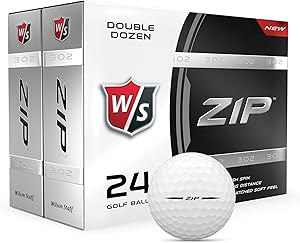
- Dimple Pattern: 302 PhD aerodynamics (flat-bottomed, shallow)
- Core: Patented zero compression core
- Cover: Speed-generating ionomer
- Quantity: Pack of 24
The WILSON Staff Zip Golf Balls, available in a convenient 24-pack, are designed for golfers seeking a blend of feel and distance, delivered through innovative technology. A standout feature is their unique 302 PhD aerodynamics dimple pattern. These aren’t your average dimples; they’re flat-bottomed and shallow, meticulously engineered to cut through the air more efficiently. This design creates a stable, penetrating flight, helping your shots stay on target and travel further, even in windy conditions.
At the heart of the Wilson Zip is its patented zero compression core. This core technology works in harmony with a speed-generating ionomer cover to achieve a remarkable balance: offering a soft feel on impact while still promoting impressive distance. The soft feel is particularly appreciated around the greens for delicate touch shots. For those who prioritize a responsive feel without sacrificing yardage off the tee, the Wilson Staff Zip presents a compelling budget-friendly option. Its composite construction ensures durability.
- Pros:
- Stable and penetrating flight
- Excellent feel around the greens
- Good distance for a zero-compression core
- Cons:
- May not suit very high swing speeds
- Limited color options (typically white)
3. TaylorMade Noodle Long & Soft Golf Balls

- Cover: Durable and soft iothane
- Core: Impact propulsion, Ultra-Soft 34 Compression
- Feel & Spin: Great feel and increased spin around greens
- Flight: Patented dimple design for straighter flight
The TaylorMade Noodle Long & Soft Golf Balls live up to their name by delivering a compelling combination of impressive distance and a remarkably soft feel. Central to their performance is the ultra-soft 34 compression core, which provides exceptional feedback and a pleasant sensation on impact, particularly on delicate shots around the green. This soft feel, combined with an iothane cover, also contributes to increased spin control when you need it most. For golfers seeking to improve their touch without sacrificing length, the Noodle offers an excellent balance.
Adding to their appeal, the Noodle Long & Soft golf balls feature an impact propulsion core designed to maximize energy transfer. This means you can expect to see your shots travel further down the fairway. The patented dimple design further enhances performance by promoting a straighter flight path, effectively reducing hooks and slices. This combination of soft feel, substantial distance, and improved accuracy makes the TaylorMade Noodle a highly versatile and forgiving option for a wide range of golfers.
- Pros:
- Remarkably soft feel
- Good distance off the tee
- Increased spin around the greens
- Cons:
- Durability may not match premium balls
- Might not suit very high swing speeds for optimal spin
4. TaylorMade Distance+ Golf Balls

- Core: REACT Speed Core
- Dimple Pattern: Extended Flight Dimple Pattern
- Alignment: Plus Alignment Aid
- Construction: Two-layer, ionomer cover
The TaylorMade Distance+ Golf Balls are engineered with a singular focus: maximizing distance for golfers of all skill levels. At its heart is the REACT Speed Core, specifically designed to generate explosive ball speed on impact, translating directly into impressive yardage off the tee. This core technology ensures that energy transfer is optimized, propelling the ball further down the fairway with every swing. Complementing the core, the all-new Extended Flight Dimple Pattern plays a crucial role in the ball’s aerodynamics. It’s designed to reduce drag and promote a higher, more penetrating flight, allowing the ball to fight through wind and stay airborne longer for maximum carry and overall distance.
Beyond raw power, the Distance+ also incorporates thoughtful features to enhance your overall game. The integrated Plus Alignment Aid on the ball surface is a simple yet highly effective tool, making it significantly easier to line up your putts and tee shots accurately. This added precision can shave strokes off your game by improving your aiming consistency. With a two-layer construction and a durable ionomer cover, these balls offer a mid-launch, max distance, and a softer feel than many pure distance balls. They provide a balanced performance that makes them a quality addition for both men’s and women’s golf collections, perfect for enjoying a casual round while still aiming for those extra yards.
- Pros:
- Exceptional ball speed and distance
- Enhanced flight stability in wind
- Effective Plus Alignment Aid
- Cons:
- Greenside spin may be limited
- Not a multi-layer tour performance ball
5. WILSON Profile Distance Golf Balls

- Core: High energy core
- Compression: Low compression technology
- Cover: Specially designed inner cover
- Dimple Pattern: Spin reducing
The WILSON Profile Distance Golf Balls, conveniently packaged in a 36-pack, are engineered to help golfers achieve longer drives and straighter shots without compromising on feel. At the core of their design is a high-energy core that serves as the engine for impressive distance. This core efficiently transfers energy upon impact. Complementing this, the low compression technology incorporated into these balls provides a surprisingly soft feel, which is a desirable characteristic often associated with more premium, higher-priced options. This soft feel enhances feedback, especially on shorter shots and around the green.
A key innovation in the WILSON Profile Distance balls is the spin-reducing dimple pattern technology. This design is specifically formulated to minimize unwanted hooks and slices, promoting a much straighter ball flight. For golfers who struggle with accuracy off the tee or with their longer irons, this feature can be a game-changer. Furthermore, a specially designed inner cover contributes to “Tour accuracy” by creating less overall ball spin, further maximizing distance. This combination of distance, soft feel, and spin reduction makes the WILSON Profile an excellent value proposition for golfers looking to improve their consistency and length on a budget.
- Pros:
- Excellent long distance flight
- Soft feel due to low compression
- Significantly reduces hooks and slices
- Cons:
- Greenside spin control may be limited
- Not designed for advanced shot shaping
6. Top Flight Reload Recycled Golf Balls

- Type: Recycled golf balls
- Performance: No performance loss vs. new balls (lab tested)
- Quantity: 12-Pack
- Value: Approximately half the price of new
The Top Flight Reload Recycled Golf Balls offer an incredibly compelling option for budget-conscious golfers and those committed to sustainability. The primary appeal lies in their cost-effectiveness, typically available for at least half the price of brand-new golf balls. This makes them an ideal choice for practice rounds, beginners who are prone to losing balls, or any golfer simply looking to save money without a significant compromise on quality. Opting for recycled balls also contributes to reducing waste, making it an environmentally friendly choice in your golfing endeavors.
Crucially, the performance of these recycled balls has been professionally tested by an independent lab, which found no measurable performance loss between a new golf ball, a recycled golf ball, and a refinished golf ball. This means you can confidently expect consistent distance, feel, and control that is comparable to new balls, but at a fraction of the cost. While the packaging may vary, the quality of the balls inside remains reliable. The 12-pack provides a good quantity to stock up on, ensuring you have enough balls for several rounds or extensive practice sessions, allowing you to focus on your game rather than worrying about the cost of lost balls.
- Pros:
- Significantly more affordable than new balls
- Eco-friendly and sustainable choice
- Lab-tested with no performance loss
- Cons:
- Cosmetic appearance may vary slightly
- Specific models within the pack are randomized
7. Callaway Warbird Golf Balls

- Core: Extra-large, high-energy
- Aerodynamics: HEX Aerodynamics
- Cover: Optimized ionomer
- Construction: 2-piece design
The Callaway Warbird Golf Balls are specifically engineered for golfers who prioritize maximum ball speed and explosive distance off every club in their bag. At the heart of the Warbird’s impressive performance is an extra-large, high-energy core. This core is designed to be highly compressible, which means it efficiently transfers energy from your clubface to the ball, resulting in higher initial ball velocity. For players looking to unlock more potential distance, especially on their drives, the Warbird is built to deliver those extra yards without demanding a tour-level swing speed.
Further enhancing its distance capabilities, the Warbird incorporates Callaway’s renowned HEX Aerodynamics. This innovative dimple pattern is expertly crafted to reduce drag and promote an increased launch angle, leading to more speed, a better ball flight, and ultimately, even greater overall distance. This aerodynamic efficiency helps the ball cut through the air, maintaining its speed and trajectory. Despite its focus on distance, the optimized ionomer cover and large core also work together to provide a respectable feel and greenside control from a simple yet effective 2-piece design.
- Pros:
- Exceptional ball speed and distance
- Reduced drag with HEX Aerodynamics
- Good launch for maximum carry
- Cons:
- Greenside spin might be limited compared to multi-layer balls
- Not designed for advanced shot shaping
How to Choose Budget Golf Balls
Golf is a fantastic sport, but it can quickly become an expensive hobby, especially when you factor in equipment, green fees, and the seemingly endless supply of golf balls that vanish into the rough or splash into water hazards. For many golfers, particularly recreational players, high-end, premium golf balls simply aren’t a practical choice. This is where inexpensive golf balls shine. They offer a compelling blend of performance, durability, and affordability, allowing you to enjoy your game without constantly worrying about the cost of a lost ball. Choosing the right cheap golf ball, however, involves more than just picking the cheapest option. It requires understanding what makes a golf ball perform and how those characteristics align with your game. This comprehensive guide will walk you through the essential factors to consider, ensuring you pick the best budget golf balls that elevate your play without emptying your wallet.
Why Go for Budget Golf Balls?
The allure of budget golf balls isn’t just about saving money, though that’s a significant factor. For the average golfer, especially those with handicaps above 15, the performance differences between a $5 premium ball and a $1.50 budget ball are often negligible in terms of scoring. The majority of players won’t be able to consistently extract the subtle spin and feel benefits that advanced, multi-layer balls offer. Moreover, losing an expensive ball can be frustrating, impacting your focus and enjoyment. Budget balls mitigate this “loss aversion,” allowing you to swing more freely and experiment without financial penalty. They are perfect for practice, casual rounds, and for beginners who are still refining their swing and prone to mis-hits.
Key Factors to Consider When Choosing Golf Balls
1. Construction: Layers and Materials
Golf balls are typically categorized by their construction, specifically the number of layers they possess. For cheaper balls, you’ll primarily encounter 2-piece designs, though some excellent 3-piece options exist at the higher end of the budget spectrum.
- 2-Piece Balls: These are the most common and cost-effective budget balls. They consist of a large, solid core (often rubber or a rubber blend) and a single, durable outer cover (typically ionomer or Surlyn).
- Pros: Maximum distance, very durable, low spin (reduces hooks/slices), affordable.
- Cons: Firmer feel, less greenside spin control, limited workability.
This construction prioritizes distance and durability, making them ideal for beginners, high-handicappers, and anyone looking to keep the ball in play off the tee.
- 3-Piece Balls: While often considered mid-range, some excellent value 3-piece balls can be found. They feature a core, an inner mantle layer, and an outer cover.
- Pros: Better feel, increased greenside spin compared to 2-piece, good blend of distance and control.
- Cons: Slightly more expensive than 2-piece, less durable than pure distance balls.
If your budget allows for a slight upgrade and you’re looking for a bit more feel and greenside performance, a 3-piece ball might be worth considering.
Cover Material: Most budget balls use Ionomer or Surlyn covers. These materials are highly durable, scuff-resistant, and contribute to the low-spin, long-distance characteristics of 2-piece balls. While they don’t offer the soft feel and high greenside spin of premium urethane covers, they provide excellent value and longevity.
2. Compression: Matching Your Swing Speed
Compression refers to how much a golf ball deforms on impact. It’s often measured on a scale from around 40 (very soft) to 100+ (very firm). Matching the ball’s compression to your swing speed is crucial for optimizing performance:
- Low Compression (Soft Balls): Typically 60-80 compression.
- Ideal for: Slower to moderate swing speeds (under 90 mph), golfers seeking a softer feel, and those who want more distance from a more compressible core. They often reduce driver spin, leading to straighter flight for slower swings.
- Budget Relevance: Many budget balls are designed with low compression to offer a softer feel and cater to a wider range of recreational players.
- High Compression (Firm Balls): Typically 90+ compression.
- Ideal for: Faster swing speeds (over 90-100 mph) to maximize energy transfer and distance.
- Budget Relevance: Less common in pure budget categories, as high-compression often accompanies multi-layer, premium designs.
A ball that’s too firm for your swing speed won’t compress enough, leading to a “dead” feel and lost distance. Conversely, a ball that’s too soft for a fast swing might over-compress, also losing energy. For most budget-conscious golfers, a low to mid-compression ball is a safe and effective bet.
3. Dimple Pattern: Aerodynamics and Flight
The dimples on a golf ball are not just for aesthetics; they play a critical role in aerodynamics, influencing lift, drag, and ultimately, ball flight. While you won’t delve into proprietary dimple patterns like a professional tour player, understanding the general impact helps:
- Fewer/Shallower Dimples: Often associated with lower drag and a more penetrating (flatter) flight, good for distance.
- More/Deeper Dimples: Can provide more lift and a higher trajectory.
Budget balls often feature dimple patterns optimized for straightness and distance, designed to reduce side spin and provide a stable flight for the average swing.
4. Spin Characteristics: Distance vs. Control
Spin is a trade-off in golf ball design, especially at the budget level:
- Low Spin Balls:
- Off the Driver: Reduces side spin, leading to straighter drives and more distance (as less energy is wasted on spin).
- Around the Green: Offers less spin, making it harder to stop the ball quickly on the greens.
- Budget Relevance: Most budget 2-piece balls are designed for low spin off the driver.
- High Spin Balls:
- Off the Driver: Can lead to more hooks and slices if not struck perfectly.
- Around the Green: Provides more control, allowing for “checking up” the ball near the pin.
- Budget Relevance: Rare in budget balls; this is a premium ball characteristic.
For most budget golfers, prioritizing low spin off the tee for straighter, longer drives is usually the smarter choice. Sacrificing some greenside spin for consistency and distance is a common and reasonable compromise.
5. Durability: Lifespan of Your Ball
Budget golf balls often excel in durability thanks to their tough Surlyn or ionomer covers. If you’re someone who hits a lot of cart paths, trees, or just generally puts your balls through the wringer, a durable ball is key. A ball that scuffs or cuts easily will perform inconsistently and need frequent replacement, negating any initial cost savings. Look for terms like “cut-proof” or “highly durable cover” in product descriptions.
6. Visibility and Color Options
While traditional white golf balls are standard, many budget options come in vibrant colors like yellow, orange, or even matte finishes. These colors can significantly improve visibility, especially in challenging light conditions, cloudy days, or when playing in areas with dense rough or fall foliage. If you frequently lose balls simply because you can’t spot them, a brightly colored budget ball could be a game-changer.
7. Recycled or Refurbished Golf Balls
For the ultimate in budget-friendliness and sustainability, consider recycled or refurbished golf balls. These balls are recovered from golf courses and then sorted, cleaned, and sometimes re-finished.
- Recycled: Cleaned and sorted based on condition (e.g., A-grade, B-grade). They retain their original cover and core properties. Professional tests often show no significant performance loss.
- Refurbished: Often involve stripping the original cover and reapplying a new one. While they look like new, this process can subtly alter the original performance characteristics.
Recycled balls, particularly higher grades, offer incredible value and are an environmentally conscious choice. You can often find premium brand balls at budget prices through this route.
Matching the Ball to Your Game and Skill Level
The “best” budget golf ball isn’t a universal product; it’s the one that best suits *your* game.
- Beginners/High Handicappers: Prioritize distance, straightness, and durability. Low compression, 2-piece balls with tough covers are your best friends. Don’t worry about greenside spin yet.
- Mid Handicappers: You might start looking for a balance. A slightly softer 2-piece or a value 3-piece ball could offer a bit more feel and control without sacrificing too much distance or breaking the bank.
- Slower Swing Speeds: Definitely lean towards low compression balls for maximum distance and a softer feel.
- Faster Swing Speeds (on a budget): Look for 2-piece balls that emphasize distance and have a slightly firmer feel, but understand you’ll be sacrificing some greenside spin and workability compared to premium balls.
- Frequent Ball Losers: Opt for multi-packs of highly durable, affordable 2-piece balls, or explore recycled options.
Testing and Experimentation
Even within the budget category, different golf balls will feel and perform slightly differently for each individual. Don’t be afraid to buy a sleeve or a small pack of a few different budget models that catch your eye. Take them to the driving range and then onto the course. Pay attention to:
- How they feel off the driver, irons, and wedges.
- Their trajectory and distance.
- Their behavior around the greens (e.g., how much they roll out on chips and pitches).
- Their durability after a few rounds.
What works wonders for one golfer might not be ideal for another, even with similar swing speeds. Personal preference plays a huge role.
Where to Buy Budget Golf Balls
Beyond your local pro shop (which often stocks premium brands), consider these avenues for budget balls:
- Online Retailers: Amazon, Golf Galaxy, Dick’s Sporting Goods, and manufacturer websites often have sales and bulk discounts.
- Sporting Goods Stores: Good for seeing balls in person and checking for clearance deals.
- Warehouse Clubs: Costco or Sam’s Club can offer excellent bulk deals on certain brands.
- Specialized Recycled Ball Retailers: Websites like LostGolfBalls.com or GolfBallsDirect.com are great sources for recycled options.
Conclusion
Choosing the best budget golf ball is about making smart, informed decisions that align with your game and financial comfort. By understanding the basics of golf ball construction, compression, spin, and durability, you can confidently select balls that will enhance your performance without the hefty price tag. Remember, a golf ball doesn’t have to be expensive to be effective. Focus on what truly benefits your swing and playing style, experiment with a few options, and you’ll find that the fairways and greens are just as enjoyable with a budget-friendly companion.