
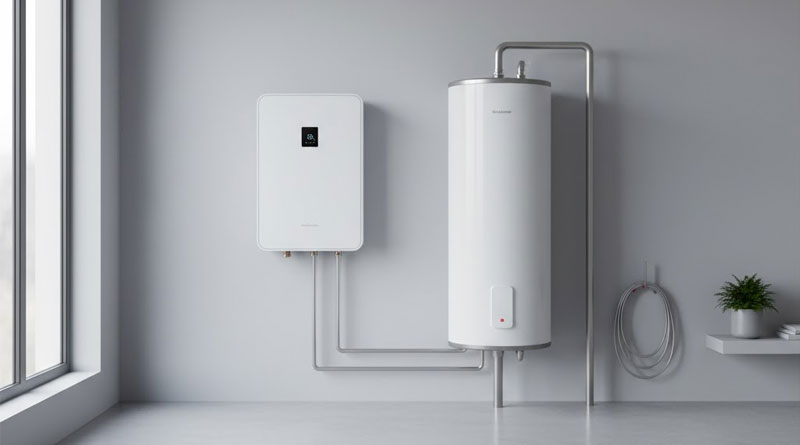
Best Budget Water Heaters of 2025
Budget-friendly hot water solutions don’t have to compromise on efficiency or comfort. Finding the ideal water heater that fits your financial plan while still delivering reliable warmth is entirely achievable with a little research. This guide cuts through the noise, offering insightful reviews of the market’s top-performing, economically priced water heaters.
1. ECOTINYMACH 110V Tankless Water Heater

- Compact Design: Space-saving footprint, ideal for under-sink installation.
- Convertible Temperature Scale: Switch between Fahrenheit and Celsius for preferred monitoring.
- Easy Installation: Designed for quick and straightforward setup.
- Electric and Energy Efficient: Tankless operation reduces energy consumption and carbon footprint.
The ECOTINYMACH 110V Tankless Water Heater offers an incredibly compact and efficient solution for point-of-use hot water needs, perfectly suited for a single sink in a kitchen, bathroom, or utility room. Its small footprint means it easily fits under sinks or in tight spaces where a traditional tank heater would be impractical. This 3000W unit provides instant hot water without the wait, making it a budget-friendly way to get on-demand warmth precisely where you need it, avoiding the energy waste associated with heating and storing water in a large tank. The unique ability to convert between Fahrenheit and Celsius on its display adds a layer of user convenience, allowing for comfortable temperature monitoring.
Designed with simplicity in mind, installation is straightforward, saving both time and potential labor costs. Its electric, tankless operation not only contributes to energy savings but also positions it as an environmentally conscious choice. While the 3000W power is ideal for low-flow applications, it’s important to note that it’s best for single faucet use rather than showers or multiple fixtures due to its capacity to raise water temperature effectively. For anyone seeking an affordable, space-saving, and efficient hot water supply for a specific tap, the ECOTINYMACH is a strong contender.
- Pros:
- Extremely compact, ideal for small spaces.
- Instant hot water at the point of use.
- Temperature display is convertible (F/C).
- Energy-efficient tankless design.
- Cons:
- Limited to low-flow applications (e.g., one sink).
- Not suitable for whole-home use or showers.
- Requires specific electrical circuit breaker (≥ 32AMP).
- Temperature rise depends on inlet water temperature.
2. xwdzswgs 110V 3000W Under Sink Instant Water Heater
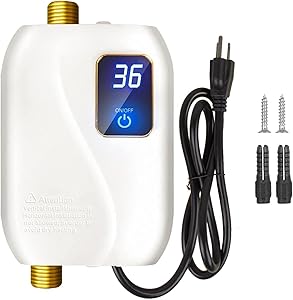
- Power Output: 3000W electric heating element.
- Digital Display: LED screen with Fahrenheit/Celsius conversion.
- Safety Features: IPX4 waterproof, leakage, dry boil, and overheat protection.
- Hot Water Delivery: Raises water 82°F (0.3GPM) – 131°F (0.5GPM) in seconds.
This 110V 3000W instant electric water heater is engineered for efficient point-of-use applications, delivering on-demand hot water without the typical preheating delays of tank units. Its sleek, ultra-thin design makes it an aesthetic and practical addition to any kitchen, bathroom, or utility sink, fitting discreetly under the counter. The digital display is a key feature, allowing users to monitor and switch between Fahrenheit and Celsius temperature scales, ensuring precise control over your hot water supply. With a thermal efficiency reaching 98%, this unit is not just convenient but also highly energy-efficient, contributing to lower utility bills.
Safety is paramount with this model, incorporating multiple layers of protection including water and electricity isolation, IPX4 waterproofing, leakage protection, dry boil prevention, and automatic power-off for overheating or inactivity. These robust features ensure reliable and worry-free operation, making it a secure choice for your home. While it excels at providing immediate hot water for washing hands or dishes, it’s crucial to note that its flow rate (0.3-0.5 GPM) is not designed for showering, which typically requires a higher GPM. Installation is designed to be straightforward with standard connections, but vertical mounting is essential for optimal performance.
- Pros:
- Provides instant, continuous hot water.
- Compact and elegant under-sink design.
- Comprehensive multi-level safety protections.
- Digital display with Fahrenheit/Celsius option.
- Cons:
- Not suitable for shower applications.
- Requires specific vertical installation.
- Flow rate impacts outlet temperature significantly.
- Needs dedicated 32A circuit breaker and 2.5mm² wiring.
3. Nessxa Portable Propane Tankless Water Heater

- Fuel Type: Propane gas.
- Flow Rate: 3.66 GPM (14L) hot water delivery.
- Power Output: 85300 BTU/hour.
- Safety Features: Six-level protection including overheat, dry combustion, antifreeze.
For adventurers and outdoor enthusiasts, this portable propane tankless water heater is a game-changer, offering the luxury of instant, endless hot water wherever your journey takes you. Its advanced combustion technology not only delivers an impressive 85300 BTU/hour, providing hot water at a rate of 3.66 gallons per minute, but also does so with reduced consumption and burning noise, making it both efficient and discreet. This unit is designed to bring comfort to remote locations, allowing for hot showers after camping, RV trips, or even bathing pets outdoors, eliminating the need to wait for water to heat up.
Beyond its powerful performance, this propane water heater prioritizes safety with an extensive six-level protection system, including safeguards against overheating, dry combustion, freezing, low water flow, flame faults, and high water pressure. The lightweight and compact design enhances its portability, featuring a convenient one-button shower head to minimize water waste. With a minimum starting pressure of just 3.6 PSI, it’s adaptable to various water sources. This heater is an excellent budget-friendly investment for anyone who desires the convenience of instant hot water for outdoor activities, offering reliability and peace of mind on the go.
- Pros:
- Highly portable and lightweight design.
- Provides high flow rate (3.66 GPM) for showers.
- Excellent energy efficiency with advanced combustion.
- Comprehensive six-layer safety protection.
- Cons:
- Requires propane tank for operation.
- Indoor use requires proper ventilation.
- Minimum water pressure (3.6 PSI) is needed to ignite.
- Temperature rise is dependent on inlet water temperature.
4. crazybrace Portable Immersion Water Heater 2000W

- Power Output: 2000W, 110-125V AC.
- Safety Guard: 304 stainless steel anti-scalding cover.
- Included Accessory: LCD digital thermometer.
- Heating Speed: Heats 5 gallons of water in minutes.
The 2000W Portable Immersion Water Heater offers an incredibly fast and budget-friendly solution for heating small to medium volumes of water in non-conductive containers. Perfect for camping, travel, or quick tasks like washing buckets, bathing pets, or even a small inflatable pool, this heater brings water up to temperature in mere minutes. Its high power output ensures efficiency, saving you both time and electricity compared to larger, slower methods. A standout feature is the robust 304 stainless steel anti-scalding guard, which safely encases the heating element, preventing direct contact with skin or objects while ensuring rapid heat dissipation into the water through its porous design.
Ease of use is key, simply ensure the heater is fully immersed in water before plugging it in. The included LCD digital thermometer is a valuable addition, allowing you to monitor the water temperature accurately and avoid guesswork. This submersible heater is a versatile tool for various situations where a fixed hot water supply isn’t available or practical, providing comfort even in cold weather. However, users must strictly adhere to the safety instructions, such as never touching the water while the heater is plugged in and avoiding continuous use for more than 3 hours to prevent hazards.
- Pros:
- Extremely portable and compact.
- Very fast heating for small volumes of water.
- Built-in 304 stainless steel anti-scalding guard.
- Includes an LCD digital thermometer for convenience.
- Cons:
- Requires strict adherence to safety warnings during use.
- Not for continuous flow or large-scale heating.
- Limited to non-conductive containers (e.g., buckets, bathtubs).
- Cannot be used for liquids other than water.
5. Nessxa Propane Gas Tankless Water Heater 3.7GPM

- Fuel Type: Propane gas, 95,540 BTU (28KW) input.
- Flow Rate: 3.7 GPM (14L/min) with 25°C temperature rise.
- Digital Display: Fahrenheit/Celsius switchable, real-time monitoring.
- Safety System: Multi-layer protection (overheat, gas leak detection, 40-minute timer).
This propane gas tankless water heater is a powerful and efficient solution for indoor hot water demands, capable of delivering 3.7 gallons per minute with a significant temperature rise of 25°C. Boasting 95,540 BTUs, it eliminates the need for preheating, providing instant hot water within seconds for showers, kitchen tasks, or garage use. Its industrial-grade construction, featuring high-quality metal housing and a UL-certified stainless steel vent pipe, ensures durability against indoor humidity and acidic combustion byproducts. The tankless design also actively minimizes limescale buildup, promoting consistent thermal output and extending the unit’s lifespan.
A standout feature is the dual-unit digital display, allowing users to easily monitor and switch between Fahrenheit and Celsius, providing precise temperature control and real-time feedback. Crucially, it incorporates a comprehensive multi-layer safety system, including overheat protection that activates at 125°F (52°C) and gas leak detection to immediately cut off the energy supply during anomalies. A 40-minute timer prevents dry burning, further enhancing safety and longevity. It’s vital to remember that this unit is designed for indoor use and requires professional installation due to complex gas piping, venting, and electrical connections to ensure safe and compliant operation.
- Pros:
- Delivers instant, high-flow hot water (3.7 GPM).
- Robust, industrial-grade materials for durability.
- Precise temperature control with digital display.
- Extensive multi-layer safety system for reliable operation.
- Cons:
- Requires professional indoor installation due to gas and venting.
- Only compatible with propane gas.
- Venting system needs a 3° downward slope to prevent erosion.
- Higher initial cost compared to small electric units.
6. VEVOR 10-Gallon Electric Tank Water Heater

- Capacity: 10 gallons (40L) storage.
- Heating Power: 1600W immersion heating element.
- Temperature Range: Adjustable 30°C to 75°C (86°F to 167°F).
- Construction: Enamel coated inner tank, HFO foam insulation.
The VEVOR 10-Gallon Electric Tank Water Heater provides a reliable and versatile hot water solution for residential and light commercial applications. With its 10-gallon capacity, this unit is perfectly sized to meet the demands of single faucets, small kitchen needs, or even a modest shower, reducing the wait time for hot water compared to drawing from a distant main heater. The 1600W immersion heating element ensures efficient and continuous hot water delivery, heating the water up to 167℉ (75℃), with an LED display and rotary knob allowing for precise temperature adjustments between 30℃ and 75℃.
Constructed for durability and safety, the heater features an enamel glass coating on the inner tank, which offers enhanced protection against corrosion, leaks, and other potential hazards, contributing to a longer lifespan. The integrated 20mm HFO foam insulation layer works effectively to retain heat for up to 24 hours, minimizing standby energy losses and contributing to overall energy efficiency. Its robust design, combined with multiple safety features and IPX4 waterproofing, ensures worry-free use. This compact yet capable unit is ideal for supplemental hot water needs in various settings, from homes and apartments to airports and small commercial spaces.
- Pros:
- Generous 10-gallon capacity for point-of-use needs.
- Efficient 1600W heating element for quick heating.
- Durable enamel-coated inner tank for longevity.
- Excellent HFO foam insulation retains heat for prolonged periods.
- Cons:
- Not a true “instant” (tankless) heater; has recovery time.
- Larger footprint compared to under-sink tankless models.
- 1600W may lead to slower recovery if fully depleted.
- Side connection might require specific plumbing setup.
7. Nessxa 1.8 Gallon Electric Mini Tank Water Heater

- Capacity: 1.8 gallons (mini tank).
- Power Output: 110V, 1500W electric heating.
- Temperature Control: Adjustable 77℉ – 176℉ (25℃ – 80℃).
- Construction: ABS exterior, stainless steel internal tank.
This 1.8 Gallon Electric Mini Tank Water Heater is an excellent solution for immediate hot water at a single point of use, such as a kitchen or bathroom sink, where hot water delivery from a main heater might be slow. Its ultra-compact design allows for versatile installation, either wall or floor-mounted directly under a sink or counter, maximizing space efficiency. The 1500W heating element rapidly heats the small tank of water, ensuring that you get instant hot water on demand without wasting water while waiting for it to warm up. This not only enhances convenience but also contributes to water conservation efforts.
Equipped with a wide temperature adjustment range (77℉ – 176℉), you can easily set your desired water temperature with a simple rotary knob. An intelligent standby mode further optimizes energy use; when the water temperature falls below 77℉, the heater automatically enters standby, preventing unnecessary power consumption. Constructed with an ABS exterior and a durable stainless steel internal tank, this unit ensures effective water and electricity isolation for safe operation and fast heating. Ideal for homes, hotels, or any scenario requiring a reliable, localized hot water supply, especially in colder climates, it offers a budget-friendly way to enjoy immediate warmth.
- Pros:
- Delivers instant hot water at point of use.
- Ultra-compact design for under-sink installation.
- Energy-saving standby mode.
- Wide and precise temperature control.
- Cons:
- Very limited capacity, not for showers or multiple fixtures.
- Requires professional installation for optimal use.
- Recovery time needed if the small tank is fully drained.
- Not suitable for whole-home hot water needs.
How to Choose Budget Water Heaters
Navigating the world of water heaters can be daunting, especially when trying to stick to a budget. However, finding an affordable unit doesn’t mean sacrificing comfort or efficiency. The key lies in understanding your specific hot water needs and how different budget-friendly options can meet them without breaking the bank. A smart purchase considers not just the upfront cost, but also installation expenses, long-term energy consumption, and the unit’s lifespan. This comprehensive guide will walk you through the essential factors and types of cheap water heaters, empowering you to make an informed decision for your home or specific application.
Understanding Different Types of Water Heaters
Water heaters come in various forms, each suited for different applications and offering distinct advantages in terms of cost and performance. Understanding these types is the first step in narrowing down your options and ensuring you select a heater that aligns with your household’s demands and your financial plan.
Tankless Electric Water Heaters
Often compact and designed for point-of-use applications, these units heat water on demand as it flows through, eliminating standby energy losses associated with traditional tank heaters. They are excellent for a single sink, an RV, or a small cabin where space is limited and consistent, low-flow hot water is needed. While the initial cost can be slightly higher than an immersion heater, their energy efficiency can lead to significant long-term savings. Installation typically involves electrical wiring, which might require a dedicated circuit for higher wattage models.
Tankless Propane/Gas Water Heaters
Similar to their electric counterparts, propane or natural gas tankless heaters also provide hot water on demand, but often offer higher flow rates, making them suitable for multiple fixtures or even entire small homes. Propane models are particularly popular for off-grid living, cabins, or large outdoor setups due to their portability and efficiency. While the fuel cost for propane can be attractive, these units require a gas line connection and proper venting, which adds to the installation complexity and cost. They are generally more powerful than budget electric tankless units but require more involved setup.
Mini-Tank (Point-of-Use) Water Heaters
These small, compact electric heaters, typically ranging from 1 to 7 gallons, bridge the gap between tankless and traditional tank heaters. They store a small amount of hot water, providing instant hot water at a specific faucet, like under a kitchen or bathroom sink. They eliminate the wait time for hot water to travel from a distant main water heater, saving both water and energy. Installation is usually simpler than larger tankless units, often just requiring a standard 120V outlet. While they don’t offer endless hot water, their immediate delivery for specific taps makes them a convenient and energy-saving budget choice.
Portable Immersion Heaters
For the cheapest and most portable hot water needs, immersion heaters are a basic but effective option. These electric coils are submerged directly into a bucket, bathtub, or other non-conductive container to heat water. They are incredibly inexpensive and highly portable, perfect for camping, emergency hot water, or heating water for chores. However, they are manual, require constant supervision, and come with strict safety precautions. They are not a solution for continuous hot water flow but excel at heating small volumes quickly and affordably.
Key Factors to Consider When Buying a Water Heater
Beyond the type, several crucial factors influence the overall value and suitability of a affordable water heater. Evaluating these points against your specific requirements will help ensure you make the best purchase for your money.
Energy Efficiency and Operating Costs
The purchase price is just one part of the equation; operating costs over the heater’s lifespan can be substantial. Look for units with a high Energy Factor (EF) or Uniform Energy Factor (UEF) rating, as these indicate better efficiency. Tankless models generally boast higher efficiency due to no standby heat loss, while mini-tanks often feature good insulation to minimize heat escape. For propane models, consider the cost and availability of propane in your area. An initially more expensive but highly efficient unit might save you more in utility bills over time.
Capacity or Flow Rate (GPM)
This is perhaps the most critical factor. For tankless heaters, consider the Gallons Per Minute (GPM) needed for your intended use. A single sink might need 0.5-1 GPM, while a shower typically requires 1.5-2 GPM. Budget electric tankless units often have lower GPMs, making them better for single, low-flow fixtures. For mini-tank heaters, the gallon capacity (e.g., 1.8 gallons, 10 gallons) directly determines how much hot water is readily available. Don’t underestimate your needs; buying a unit that’s too small will lead to frustration and potentially higher energy usage as it struggles to keep up.
Fuel Type and Requirements
Inexpensive water heaters primarily use electricity or propane/natural gas. Electric heaters are generally easier to install as most homes have existing electrical infrastructure, but higher wattage models might require dedicated 240V circuits and specific amperage breakers. Propane/gas heaters often have lower running costs but demand professional installation for gas lines and venting to ensure safety and compliance with local codes. Factor in the availability and cost of the fuel source, as well as any necessary upgrades to your home’s infrastructure.
Installation Complexity and Costs
The “budget” aspect can quickly diminish if installation is complicated or expensive. Point-of-use electric units are often DIY-friendly, especially 120V plug-in models. However, 240V electric tankless units and all propane/gas models frequently require professional installation due to electrical, plumbing, or venting requirements. Always factor in potential professional labor costs, permits, and any necessary upgrades to your electrical panel or gas lines when calculating the true budget impact.
Size, Space, and Portability
Consider where the heater will be located. Tankless and mini-tank units are ideal for under-sink or wall-mounted installations in tight spaces. Portable propane units are designed for outdoor or mobile use. Traditional small tank heaters might take up more room but offer a consistent reservoir of hot water. Ensure the unit’s dimensions fit your available space, and consider its weight if portability is a factor.
Safety Features and Durability
Even on a budget, safety should never be compromised. Look for features like overheat protection, dry-boil protection, leakage detection, pressure relief valves, and IPX4 waterproofing. For immersion heaters, an anti-scalding guard is crucial. Durability is also important for longevity; stainless steel components, robust insulation, and high-quality construction contribute to a longer lifespan and fewer maintenance issues down the road. Read reviews for insights into real-world reliability.
Maximizing Your Budget Heater’s Lifespan and Efficiency
Once you’ve chosen your cheaper water heater, proper installation and routine maintenance are key to ensuring it operates efficiently and lasts as long as possible. Follow manufacturer instructions meticulously for installation, and if in doubt, opt for professional help, especially for gas or high-voltage electric units. For tankless models, annual flushing can prevent mineral buildup. For mini-tanks, checking connections and insulating exposed pipes can enhance efficiency. Setting the temperature appropriately – typically between 120°F and 125°F for most uses – balances comfort with energy savings.
Common Mistakes to Avoid
A common pitfall is underestimating installation costs, leading to a “budget” purchase becoming unexpectedly expensive. Another mistake is purchasing a unit with insufficient capacity for your needs, resulting in inadequate hot water and higher energy consumption as the unit constantly cycles. For portable immersion heaters, neglecting safety warnings can be dangerous. Always read the manual thoroughly, understand the limitations of your chosen model, and never compromise on safety for a lower price point.
Conclusion
Choosing the best budget water heater is about smart decision-making, not just finding the lowest price tag. By understanding the different types available, carefully evaluating your hot water requirements, and considering long-term operating and installation costs, you can select a unit that provides reliable, efficient hot water without straining your finances. Whether it’s a compact tankless unit for a single sink, a portable propane heater for adventures, or a mini-tank for instant point-of-use warmth, there’s a budget-friendly option out there to keep you comfortably supplied with hot water.