Best Fillet Knives For Saltwater Fish of 2025
For any angler targeting saltwater species, a reliable fillet knife isn’t just a luxury; it’s an essential tool. The harsh marine environment demands blades that are not only exceptionally sharp for clean, efficient processing but also engineered to withstand the relentless corrosive effects of salt and moisture. Beyond sharpness, critical factors like a comfortable, non-slip grip for safety in wet conditions, and a durable, well-ventilated sheath for protection and longevity, become paramount.
1. Calamus Fishing Fillet Knife – German G4116 Stainless
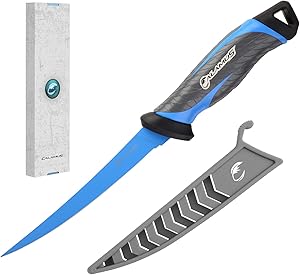
- Blade Material: G4116 German Stainless-Steel
- Blade Coating: Blue corrosion-resistant finish
- Handle Material: Non-Slip Golf Style Rubber
- Sheath: Vented Nylon Sheath
The Calamus Fishing Fillet Knife stands out as a versatile and reliable choice for both freshwater and saltwater anglers. Featuring razor-sharp G4116 German Stainless-Steel blades, this knife is designed for superior edge retention and efficiency, making quick work of filleting and steaking fish. The unique blue corrosion-resistant coating not only gives it a fresh, clean aesthetic but significantly enhances its durability against the elements, particularly in salty marine conditions. With multiple lengths and shapes available, from a stiff 5” bait knife to flexible 7” and 9” fillet knives, and a robust 9” steaking knife, Calamus ensures you have the ideal fixed blade for any task.
Ergonomics and safety are paramount with the Calamus fillet knife. Each model boasts a comfortable, non-slip, golf-style rubber handle, providing an exceptionally secure grip even in wet and slimy conditions. These handles are also notably lighter than many competitors, reducing hand fatigue during prolonged use. Furthermore, every knife comes with a lightweight, durable, and vented nylon sheath. This thoughtful design protects the blade and allows for crucial air circulation and water drainage, preventing corrosion and maintaining the knife’s pristine condition between uses. It’s a highly functional tool that performs well across various fishing and kitchen applications.
- Pros:
- Razor-sharp German stainless steel blade
- Excellent corrosion resistance for saltwater
- Comfortable, non-slip golf-style handle
- Cons:
- “Golf style” handle aesthetics not for everyone
- Nylon sheath less rigid than molded plastic
2. HOSHANHO Fillet Knife 7 Inch – Japanese High Carbon Stainless Steel

- Blade Material: Japanese 10Cr15CoMoV High Carbon Stainless Steel
- Edge Angle: Hand polished 15 degrees per side
- Handle Material: Durable Pakkawood
- Blade Length: 7 inches, thin and flexible
The HOSHANHO Fillet Knife delivers exceptional performance with its premium Japanese 10Cr15CoMoV high carbon stainless steel blade. This superior material ensures the knife is remarkably durable, harder, and significantly sharper than many conventional options, boasting a hand-polished edge at an acute 15 degrees per side for ultimate precision. The 7-inch thin and flexible blade is expertly designed to glide through fish flesh and around bones, making the intricate tasks of slicing, boning, trimming, and skinning effortless. This results in clean, professional-grade fillets with minimal waste, enhancing your overall processing efficiency.
Beyond its cutting prowess, the HOSHANHO fillet knife features an ergonomically designed handle crafted from durable pakkawood. This handle provides a comfortable and secure grip, effectively reducing user fatigue during extended periods of use. Pakkawood is also known for its good resistance to corrosion and abrasion, contributing to the knife’s overall longevity. Its lightweight and flexible nature allows for greater control and adaptability to the contours of the fish, improving both precision and work efficiency. This knife isn’t just for fish; its versatility extends to cutting various meats, making it a functional and aesthetically pleasing addition to any kitchen, and a perfect gift for culinary enthusiasts.
- Pros:
- Exceptional sharpness with 15-degree edge
- High-quality Japanese high carbon stainless steel
- Ergonomic and durable pakkawood handle
- Cons:
- Pakkawood handles can be less slip-resistant when wet
- Only available in one length (7 inches)
3. KastKing Spartacus Fillet Knife – Cerakote Coated 8Cr14 Stainless

- Blade Material: 8Cr14 Stainless-Steel
- Blade Coating: Cerakote Ceramic Finish
- Handle Material: Kraton G Polymer
- Sheath: Protective Molded Knife Sheath
The KastKing Spartacus Fillet Knife is engineered for the demanding conditions of saltwater fishing, combining high-performance materials with exceptional value. Its ultra-sharp 8Cr14 Stainless-Steel blade boasts a higher carbon content for superior edge retention and increased chromium for enhanced corrosion resistance, surpassing many competitive knives. What truly sets this knife apart is its Cerakote ceramic finish, a high-temperature coating renowned for providing industry-leading corrosion protection. This advanced ceramic layer, often found on high-end firearms, ensures the blade withstands the harshest marine environments, delivering long-lasting performance and durability that anglers can depend on.
Comfort and safety are further optimized through the Spartacus’s Kraton G Polymer handle. This highly UV-resistant material provides a comfortable and secure non-slip grip, performing consistently well across all temperatures and wet conditions commonly encountered during fish processing. Each knife also includes a lightweight yet durable molded sheath, designed specifically to protect the blade and ensure safe storage. Unlike fabric cases, this molded sheath features drainage points that prevent water retention and promote air circulation, effectively combating corrosion and keeping the blade in prime condition between uses. Whether for filleting, boning, or general food prep, the KastKing Spartacus offers professional-level performance at an accessible price.
- Pros:
- Exceptional Cerakote ceramic corrosion resistance
- Durable 8Cr14 stainless-steel blade with good edge retention
- Comfortable, non-slip Kraton G Polymer handle
- Cons:
- 8Cr14 steel is good but not premium grade
- Cerakote coating can potentially chip with heavy abuse
4. Gerber Gear Controller Fillet Knife – 10″ with SALTRx

- Blade Length: 10 inches
- Corrosion Resistance: SALTRx Technology
- Handle Grip: HydroTread Grip with GuideFins
- Sheath Feature: Built-in Knife Sharpener
The Gerber Gear Controller Fillet Knife, with its imposing 10-inch blade, is expertly crafted for the serious saltwater angler. Engineered with Gerber’s proprietary SALTRx technology, this knife offers unparalleled corrosion resistance, a critical feature for enduring the harsh marine environment. The mirror-polished blade not only contributes to its sleek appearance but also further enhances its ability to resist pitting and rust, ensuring long-term durability and consistent performance. This robust construction makes it a reliable companion for processing larger catches, providing the necessary reach and strength for substantial fish species.
Beyond its formidable blade, the Controller emphasizes user control and safety. It features the innovative HydroTread Grip combined with GuideFins on the handle, meticulously designed to provide precise control for clean cuts, even when handling the most slippery of fish. This ergonomic design minimizes fatigue and maximizes stability in wet, challenging conditions. An added convenience is the integrated knife sharpener built into the sheath, allowing anglers to maintain a razor-sharp edge on the go, ensuring optimal cutting performance at all times. The Gerber Gear Controller embodies premium fishing gear, delivering a balance of robust design, superior corrosion resistance, and practical features for an efficient filleting experience.
- Pros:
- Superior saltwater corrosion resistance with SALTRx
- Excellent HydroTread Grip and GuideFins for precise control
- Convenient built-in knife sharpener in sheath
- Cons:
- 10-inch blade may be too long for smaller fish
- Specific grip style might not suit all hand preferences
5. KastKing Ultimate Angler 9″ Fillet Knife – Vanadium Stainless

Innovation extends to the functional sheath design, which is engineered for both convenience and utility. It opens fully for effortless cleaning, drastically reducing maintenance hassle, and includes a suction cup for secure attachment to boat surfaces. A built-in carabiner ensures easy transport, while an integrated blade sharpener keeps the fillet knife in top condition at all times. The sheath also features a precision line cutter, eliminating the need for additional cutting instruments and streamlining your fishing gear. Complemented by an ergonomic EnduraGrip handle, specifically designed for comfort and a non-slip grip in wet conditions, this full tang knife ensures optimal balance and fatigue-free handling, making it ideal for extended use by serious anglers.
- Pros:
- Superior sharpness and edge retention from vanadium steel
- Excellent fluoropolymer coating for corrosion resistance
- Innovative sheath with sharpener, line cutter, and suction cup
- Cons:
- 9-inch blade might be long for smaller fish
- Fluoropolymer coating can eventually wear off
6. KastKing Speed Demon Pro Fillet Knife – G4116 German Stainless
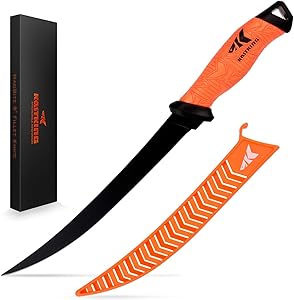
- Blade Material: G4116 German Stainless-Steel
- Blade Finish: Black corrosion-resistant finish
- Handle Material: Non-Slip Super Polymer Grip
- Blade Options: 5″ bait, 6″, 7″, 9″ fillet, 9″ steaking
The KastKing Speed Demon Pro Fillet Knife series delivers professional-level performance with its razor-sharp G4116 German Stainless-Steel blades, featuring a stylish black corrosion-resistant finish. These premium blades are designed to maintain their edge exceptionally well in both freshwater and saltwater environments, significantly easing the tasks of cutting bait, filleting fish of all sizes, and steaking larger game fish. The availability of various blade types and lengths ensures that anglers always have the perfect tool for the job – from a stiff 5” bait knife with a serrated top edge for frozen bait, to flexible 6”, 7”, and 9” fillet knives that follow natural contours, and a robust 9” steaking knife for the biggest catches.
Safety and comfort are integrated into the Speed Demon Pro’s design through its non-slip Super Polymer grips. These handles provide an exceptionally comfortable and secure hold, ensuring a solid grip even in wet and slippery conditions, thereby enhancing user safety and reducing fatigue. The handles are also easy to clean, maintaining their appearance and hygiene over time. Each knife comes complete with a lightweight and durable protective sheath, uniquely designed to lock the handle securely while allowing for quick removal when needed. The sheath’s open slots facilitate excellent water drainage, keeping the blades dry, sharp, and resistant to corrosion between uses, making it an innovative and affordable choice for serious anglers.
- Pros:
- Razor-sharp G4116 German stainless-steel blades
- Excellent edge retention in saltwater
- Comfortable and secure non-slip Super Polymer grip
- Cons:
- Black blade finish is primarily aesthetic
- Super Polymer handle not as premium as some alternatives
7. Calamus SwiftGlide Fillet Knife Kit Combo – G4116 Stainless

- Blade Material: G4116 German Stainless-steel
- Blade Treatment: Corrosion-resistant passivation
- Handle Material: Ergonomic Polypropylene
- Kit Includes: 5″ bait, 7″/9″ fillet knives, scaler, gloves, sharpener, storage bag
The Calamus SwiftGlide Fillet Knife Kit Combo offers an all-encompassing solution for anglers looking for versatility and efficiency. This comprehensive set features ultra-sharp G4116 German stainless-steel blades, enhanced with a corrosion-resistant passivation treatment to ensure precision cutting and long-lasting sharpness in both freshwater and saltwater conditions. The kit includes a versatile selection of knives: a stiff 5” bait knife with a serrated top edge for frozen bait, and flexible 7” and 9” fillet knives, perfect for delicate filleting tasks or carving meat from the bone with ease. This thoughtful array of blade options equips you for nearly any fish processing challenge.
Designed for safety and comfort, each knife in the SwiftGlide kit boasts an ergonomic polypropylene handle that provides a comfortable, non-slip grip. This secure handling maximizes control and significantly reduces hand fatigue during prolonged use, even in wet and slippery environments. Beyond the knives, the combo is packed with valuable accessories, including a professional 8” sharpening rod to maintain peak blade performance, a corrosion-resistant stainless steel fish scaler for effortless scale removal, and non-slip grip gloves for safe fish handling. Everything is neatly organized in a durable oxford storage bag, making this kit highly portable and ready for any fishing adventure.
- Pros:
- Comprehensive kit with multiple knives and tools
- Ultra-sharp G4116 German stainless-steel blades
- Excellent corrosion resistance for saltwater use
- Cons:
- Polypropylene handle may feel less premium than other materials
- Included gloves might be basic quality
How to Choose Fillet Knives For Saltwater Fish
Why a Specialized Saltwater Fillet Knife?
Filleting fish is an art, and for saltwater species, it demands specialized tools. The marine environment is incredibly harsh, presenting unique challenges that standard kitchen knives simply aren’t equipped to handle. The primary enemy is corrosion; saltwater can quickly degrade even high-quality steels not specifically treated or formulated for it.
Beyond longevity, saltwater fish often have tougher skin, denser scales, and stronger bone structures than their freshwater counterparts, requiring blades that can maintain a razor-sharp edge through demanding work. Furthermore, the act of filleting on a boat or at a slippery cleaning station necessitates a handle that offers an unyielding, non-slip grip, ensuring safety and precise control even when wet and covered in slime. Investing in a knife designed for saltwater use ensures not only a cleaner, more efficient filleting process but also extends the life of your valuable tool, making it a critical piece of gear for any serious angler.
Key Features to Look For in a Saltwater Fillet Knife
Blade Material and Corrosion Resistance
The heart of any good fillet knife is its blade, and for saltwater use, material and corrosion resistance are paramount. Most quality fillet knives are made from various types of stainless steel, but not all stainless steels are created equal. Look for alloys like 420HC, 440C, 8Cr13MoV, 8Cr14MoV, G4116 German stainless, or specialized Japanese steels like 10Cr15CoMoV and vanadium stainless. The key characteristic for saltwater performance is a high chromium content (typically 13% or more), which forms a passive layer that resists rust.
However, even high-chromium steels benefit from additional protection. Advanced coatings like Cerakote, a high-temperature ceramic finish, or fluoropolymer coatings offer superior barriers against corrosion, preventing pitting and rust even after prolonged exposure. Some manufacturers also employ passivation treatments or mirror polishes, which help to seal the surface and make it more resistant to environmental damage. Always prioritize knives that explicitly state their saltwater or enhanced corrosion resistance properties.
Blade Length and Flexibility
Choosing the right blade length and flexibility is crucial for effective filleting. The ideal length often depends on the size of the fish you’ll be processing. Generally, shorter blades (6-7 inches) are excellent for smaller panfish or inshore species, offering precision and maneuverability for delicate tasks. Mid-range blades (8-9 inches) are versatile workhorses, suitable for medium-sized fish like snapper, redfish, or mahi-mahi, balancing control with the ability to handle larger cuts. For substantial game fish such as tuna, wahoo, or large grouper, a longer blade (10 inches or more) provides the necessary reach and leverage for efficient steaking and filleting.
Blade flexibility is another important consideration. Highly flexible blades excel at delicate work, allowing you to closely follow bone structures, remove pin bones, and skin fillets with minimal waste. Stiffer blades, on the other hand, are better suited for heavier tasks like cutting through tougher bones or steaking very large, firm-fleshed fish, where more force and less bending are required. Many anglers opt for a set of knives with varying lengths and flexibilities to cover a wider range of fish sizes and processing needs.
Handle Design and Grip
The handle of a saltwater fillet knife is just as important as the blade, especially for safety and comfort in wet, slippery conditions. Look for handles made from materials that offer excellent grip even when wet and slimy, such as rubber, Kraton, or specialized polymers. Some composite materials like Pakkawood can be used, but ensure they are treated for moisture resistance and provide a textured surface. The handle’s ergonomic design should fit comfortably in your hand, reducing fatigue during extended filleting sessions. Features like finger grooves, textured patterns (e.g., golf-style, HydroTread Grip), or flared guards contribute significantly to a secure hold and prevent your hand from slipping onto the blade. A well-balanced knife, where the weight is evenly distributed between the blade and handle, also improves control and reduces strain, making for a safer and more enjoyable filleting experience.
Sheath and Storage
A well-designed sheath is an integral part of a saltwater fillet knife, offering protection for both the blade and the user. For marine environments, molded plastic sheaths with drainage holes are highly recommended. These allow water to drain away, prevent moisture retention, and promote air circulation, which is crucial for preventing corrosion. Unlike fabric or leather sheaths, plastic doesn’t absorb water or odor, making it more hygienic and durable. Many sheaths now come with integrated features like built-in sharpeners, line cutters, or belt clips and suction cups for convenient storage on a boat or cleaning station. Always ensure the sheath provides a secure fit, ideally with a locking mechanism, to prevent the knife from accidentally falling out during transport or movement. A good sheath protects your investment and keeps you safe.
Edge Retention and Sharpening
Edge retention refers to how long a blade can maintain its sharpness, while ease of sharpening is how readily that edge can be restored. These two qualities are often inversely related: harder steels (with higher HRC ratings) tend to hold an edge longer but are more challenging to sharpen. For saltwater fish, where you might be cutting through tough skin and bones, a good balance is ideal. Steels like G4116 German stainless and various high-carbon stainless steels offer a commendable balance of edge retention and relative ease of sharpening.
While some knives come with built-in sharpeners in their sheaths, these are often basic and best for quick touch-ups. For proper edge maintenance, especially for harder steels, investing in a quality sharpening system (e.g., ceramic rods, diamond stones) is recommended. Regular sharpening not only ensures optimal cutting performance but also makes the knife safer to use, as a sharp blade requires less force and is less prone to slipping.
Additional Considerations
Full Tang vs. Partial Tang
The tang of a knife refers to the portion of the blade that extends into the handle. A full tang knife means the blade extends through the entire length of the handle, offering superior strength, durability, and often better balance. This construction is highly recommended for heavy-duty tasks and ensures the knife can withstand significant stress without breaking. Partial tang knives, where the blade extends only partway into the handle, are typically lighter and less expensive, but they are generally less robust and may not be suitable for demanding saltwater applications where leverage and strength are often required.
Cleaning and Maintenance
Proper cleaning and maintenance are critical for extending the life of any saltwater fillet knife, regardless of its corrosion-resistant properties. Always rinse your knife thoroughly with fresh water immediately after each use to remove all salt, fish residue, and slime. Dry the blade and handle completely with a clean towel before storing. For non-coated stainless steel blades, applying a light coat of food-grade mineral oil can provide an extra layer of protection against moisture. Regularly inspect your knife for any signs of rust or damage, and address them promptly. Storing the knife in its proper sheath, especially one with good drainage and ventilation, further contributes to its longevity. Neglecting these simple steps can significantly shorten the lifespan of even the best saltwater fillet knife.
Brand Reputation and Warranty
When investing in a specialized tool like a saltwater fillet knife, brand reputation and warranty can provide peace of mind. Established brands in the fishing and knife industries often have a track record of quality control, innovative design, and reliable customer service. They typically back their products with warranties that cover defects in materials and workmanship, and sometimes even corrosion. Researching user reviews and brand reliability can help you make an informed decision. A good warranty indicates the manufacturer’s confidence in their product and offers protection for your investment, ensuring you get a knife that will serve you well for many seasons.
Conclusion
Choosing the best fillet knife for saltwater fish is a decision that significantly impacts your post-fishing experience. It’s not merely about having a sharp blade; it’s about finding a tool that seamlessly blends exceptional corrosion resistance with superior edge retention, an unyielding non-slip grip, and practical features designed for the harsh marine environment. Whether you’re processing a bounty of smaller inshore species or tackling a trophy offshore catch, the right knife will transform a chore into an efficient and satisfying task. By prioritizing blade material, length, handle ergonomics, and sheath design, you can select a fillet knife that not only maximizes your yield and minimizes waste but also enhances your safety and enjoyment on the water for years to come. Invest wisely, and you’ll find that a quality saltwater fillet knife quickly becomes one of your most valued pieces of fishing gear.