Best Golf Balls For Putting of 2026
A ball that feels good off the putter face, holds its line, and provides reliable feedback can instill confidence and shave strokes off your game. This guide delves into the best golf balls specifically engineered to enhance your putting, helping you navigate the options to find your perfect match for consistent, accurate rolls on the green.
1. Callaway Odyssey Weighted Putting Practice Golf Balls

- Weight: 5x heavier than a standard golf ball
- Purpose: Promotes accelerating stroke and affirmative strike
- Feedback: Immediate on off-center strikes
- Use: Backyard and on-course putting practice
The Callaway Odyssey Weighted Putting Practice Golf Balls are an excellent training aid designed to hone your putting stroke with immediate, tangible feedback. Each ball is substantially heavier, weighing five times more than a regular golf ball. This added mass forces golfers to engage their core and maintain an accelerating stroke through impact, a crucial element for consistent and solid putts. The increased weight effectively counters deceleration, helping to develop a smoother, more committed putting motion.
These practice balls are versatile enough for both backyard drills and on-course warm-ups, making them a valuable addition to any golfer’s training regimen. They specifically target stroke mechanics, encouraging solid contact and a square putter face at impact. By consistently practicing with these weighted balls, golfers can build muscle memory for an improved stroke, leading to more confidence and better results with their actual playing ball.
- Pros:
- Develops consistent stroke acceleration
- Provides immediate feedback on mishits
- Helps eliminate deceleration through impact
- Cons:
- Not for actual gameplay
- May feel unusual initially due to weight
2. Vice Tracer Golf Balls

- Technology: Visible Tracer lines for spin and roll feedback
- Construction: Available in 3-part (Pro/Pro Air) or 4-part (Pro Plus) designs
- Feedback: Real-time visual for square vs. off-center hits
- Cover: Soft Urethane for greenside feel and spin
The Vice Tracer Golf Balls bring an innovative approach to putting practice and performance with their distinctive Visible Tracer Technology. These balls feature bold, contrasting lines that offer immediate visual feedback on the spin and roll of your putts. This unique alignment aid is invaluable for golfers looking to precisely align their putter face with the target and observe the ball’s true path. When you strike the ball squarely, the tracer lines reveal a smooth, straight roll, reinforcing good mechanics.
Beyond their visual feedback capabilities, Vice Tracer balls are designed with premium construction. Depending on your swing speed, you can choose from the 3-part Pro/Pro Air or the 4-part Pro Plus models, ensuring optimal performance from tee to green. However, for putting, the consistent roll and the soft urethane cover are key, promoting excellent greenside feel and control. This combination allows for confident putts with great tactile feedback, enhancing your ability to judge pace and break.
- Pros:
- Exceptional visual feedback on roll and spin
- Aids in precise putting alignment
- Soft urethane cover for superior feel
- Cons:
- Higher price point than basic practice balls
- Bold lines may be distracting for some players
3. MAZEL Golf Practice Putting Ball
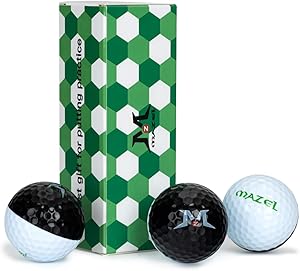
- Design: Black and white border line for visual alignment
- Target User: Golfers with unstable putting strokes
- Feedback: Instant diagnostic of stroke path
- Quantity: Pack of 3 for extended practice
The MAZEL Golf Practice Putting Ball is an ingenious yet simple training aid designed to dramatically improve putting accuracy, especially for those struggling with an inconsistent stroke. Its distinctive black and white border line serves as a highly effective visual guide, making it immediately clear whether your putter face is square at impact and if your stroke is moving straight towards the target. This immediate feedback mechanism is crucial; it helps golfers quickly identify and correct deviations.
This putting training aid isn’t just about identifying flaws; it’s about building confidence through focused practice. By making every stroke count and providing clear feedback, the MAZEL ball transforms mundane practice into an impactful learning experience. The consistent visual alignment offered by the contrasting lines ensures that you maintain a square putter face and a straight stroke path, fundamental to sinking more putts.
- Pros:
- Significantly improves putting alignment
- Provides instant visual feedback on stroke path
- Ideal for correcting unstable putting strokes
- Cons:
- Not a regulation golf ball for play
- Feedback is visual, not tactile
4. Franklin Sports Practice Golf Balls
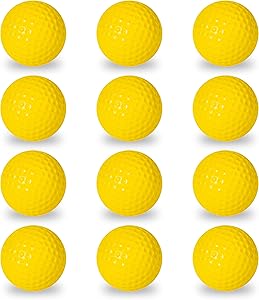
- Material: Polyurethane blend for enhanced durability
- Durability: Lab-tested to last up to 5x longer than traditional plastic balls
- Quantity: 12-pack in vibrant lime-green color
- Flight: Limited flight design for safe practice
The Franklin Sports Practice Golf Balls are an excellent choice for golfers seeking a durable, safe, and effective solution for practicing their short game, including crucial putting strokes. Crafted from a unique polyurethane blend, these balls are designed to withstand countless impacts without splitting or cracking, boasting a lab-tested durability that outlasts traditional plastic practice balls by up to five times.
Despite their robust construction, these practice balls are engineered to provide an accurate spin and feel, mimicking a regular golf ball’s performance for a realistic practice experience. This allows you to truly gauge your stroke and feel how the ball reacts, enhancing the quality of your training. Their vibrant lime-green color ensures high visibility, making them easy to spot even in taller grass, while their limited flight design prevents them from traveling too far, saving you time on retrieval.
- Pros:
- Exceptional durability for long-lasting use
- Safe for both indoor and outdoor practice
- Provides accurate spin for realistic training
- Cons:
- Not a regulation golf ball for competitive play
- Plastic feel differs from real golf balls
5. PuttOUT Devil Ball Face Angle Trainer

- Primary Focus: Improving putter’s face angle at impact
- Feedback Type: Exaggerated deviation for imperfect strokes
- Difficulty: Three built-in adjustable levels
- Inclusions: 2x Devil Balls, alignment marker, travel pouch
The PuttOUT Devil Ball Face Angle Trainer is a revolutionary tool for any golfer serious about mastering their putting stroke, particularly focusing on the critical aspect of face angle at delivery. It’s a well-known fact that face angle accounts for 90% of a putt’s starting direction, making this trainer exceptionally impactful. With its unique flat-edged impact zone, the Devil Ball is ingeniously designed to amplify the effects of an incorrect putter face angle.
This training aid is built for golfers committed to improvement, offering three distinct difficulty levels. By simply rotating the ball, you can choose to hit a rounder (easier) or flatter (harder) part, allowing for progressive challenges as your skills develop. On its most difficult setting, holing a 3-foot putt with the Devil Ball is twice as challenging as with a standard golf ball, truly pushing your precision. Each purchase includes two Devil Balls, an alignment marker, and a convenient travel pouch, alongside access to online training videos to maximize your practice.
- Pros:
- Significantly improves putter face angle at impact
- Provides exaggerated and undeniable feedback
- Offers adjustable difficulty levels for progression
- Cons:
- Can be frustrating due to amplified errors
- Not a regular golf ball for play
6. TaylorMade Tour Response Golf Balls

- Core Technology: Speedmantle with HFMq
- Durability Feature: Crosslinking chemical reaction for shear resistance
- Manufacturer: TaylorMade Golf
- Cover Material: Urethane (standard for Tour Response)
The TaylorMade Tour Response Golf Balls are engineered to deliver a blend of tour-level performance with a softer feel. At its heart is the innovative Speedmantle with HFMq, a unique core technology designed to optimize energy transfer and ball speed while maintaining a consistent feel. This construction translates into a ball that launches effectively and provides a predictable trajectory, crucial for consistent putting distance control. The engineering aims to give players the confidence of a tour-caliber ball without requiring tour-level swing speeds.
A key feature for durability and performance consistency is the crosslinking chemical reaction that creates an irreversible link for better shear resistance. This not only makes the ball more robust, maintaining its integrity through repeated impacts, but also contributes to the consistent roll and feel off the putter face. For putting, this means a reliable response and a true roll, shot after shot. The soft urethane cover, characteristic of the Tour Response line, further enhances greenside feel and spin control, allowing for subtle adjustments and precise touch around and on the green.
- Pros:
- Tour-level feel and control on putts
- Speedmantle with HFMq for consistent speed
- Excellent shear resistance for durability
- Cons:
- Higher price point than many other options
- May not provide maximum distance for all swings
7. Callaway Recycled Golf Balls (Assorted)

- Selection: Assorted models of Callaway golf balls
- Condition: Recycled, washed, and cleaned; Fair to good condition
- Original Specs: Not altered during recycling process
- Packaging: Drawstring Mesh Onion Skin Bag for storage
For golfers looking for an economical and environmentally conscious option for practice or casual rounds, the Callaway Recycled Golf Balls (Assorted) offer an excellent solution. This bag provides a mix of various Callaway models, giving players the opportunity to experiment with different feels and performances without the premium price tag of new balls. Each ball undergoes a thorough recycling process, where it’s washed and cleaned, ensuring that while it’s pre-owned, it arrives in fair to good condition, ready for immediate use.
These recycled balls are particularly great for putting practice, where the occasional lost ball isn’t as much of a financial concern. You can experiment with how different Callaway models feel off the putter face, how they roll, and how they react to various green speeds. While the assortment means some inconsistency in feel between individual balls, it also provides valuable learning experience in adapting to different ball types. Stored conveniently in a drawstring mesh bag, these balls are easy to transport and keep organized.
- Pros:
- Highly cost-effective compared to new balls
- Offers variety of Callaway models for testing
- Good for practice, casual rounds, and beginners
- Cons:
- Inconsistent feel due to assorted models
- Balls are in fair to good condition, not mint
How to Choose Golf Balls For Putting
Choosing the right golf ball for putting isn’t just about picking a premium brand; it’s about understanding how a ball’s construction, feel, and performance attributes align with your stroke and the demands of the course. A well-chosen ball can instill confidence, provide crucial feedback, and ultimately help you sink more putts, leading to lower scores and greater enjoyment on the course. This comprehensive guide will walk you through the essential factors to consider when selecting the best golf balls to elevate your putting game.
Understanding Golf Ball Construction and How It Affects Putting
Every golf ball is a marvel of engineering, comprising multiple layers designed to optimize performance from tee to green. For putting, specific aspects of this construction become particularly important. Understanding these components can help you make an informed decision.
The Core: Compression and Feel
The core is the innermost layer of a golf ball and largely dictates its compression, which in turn affects the feel off the putter face. Cores can be soft or firm. A softer core generally leads to a lower compression ball, which compresses more upon impact. For putting, this often translates to a softer, more responsive feel, allowing for greater finesse and feedback. Golfers who prefer a more “buttery” feel and seek to control distance through touch often gravitate towards lower compression balls. Conversely, a firmer core, found in higher compression balls, offers a crisper, sometimes more “clicky” feel. While less common for putting preference, some players prefer this firmer feel for better control on fast greens or a more direct energy transfer.
The Mantle Layers: Energy Transfer and Control
Surrounding the core are one or more mantle layers. These layers are crucial for transferring energy from the clubface to the core, influencing ball speed, spin, and launch. While their primary role is often highlighted in full swing performance, mantle layers do contribute to the overall feel and stability of the ball on putts. They help maintain the ball’s shape and provide structural integrity, which is essential for a consistent roll. For putting, mantle layers, particularly in multi-layer balls, can enhance the ball’s ability to hold its line and resist minor deviations caused by imperfections on the green or slight mis-hits.
The Cover: Softness, Spin, and Durability
The outermost layer, the cover, is perhaps the most critical component affecting putting performance. Golf ball covers are typically made from urethane or ionomer. Urethane covers are softer and provide superior greenside spin, feel, and control. This softness allows the ball to grip the putter face slightly more, leading to a truer roll and better distance control, especially on delicate putts. Urethane also offers excellent feedback, letting you feel the impact more distinctly. Ionomer covers, while more durable and often found on distance or value balls, are generally firmer. They offer less greenside spin and a harder feel, which some golfers might find less desirable for putting touch. For optimal putting performance, a soft urethane cover is almost always preferred due to its feel and ability to promote a consistent roll.
Key Factors When Choosing a Putting Ball
Beyond construction, several performance factors directly influence how a ball behaves on the green. Understanding these can help you narrow down your choices.
Feel and Softness
The feel of a golf ball off the putter face is highly personal but undeniably crucial. A softer ball typically offers more feedback and a more muted sound upon impact, which many golfers find appealing for touch and finesse putts. It provides a sensation of the ball “staying” on the putter face longer, allowing for better control over delicate rolls. A firmer ball, on the other hand, might offer a more immediate, “crisper” feel and sound. The ideal feel depends entirely on your preference and what gives you the most confidence to execute your stroke consistently.
Roll Consistency and Alignment
A golf ball’s ability to roll true and hold its intended line is paramount in putting. Premium balls are engineered for exceptional balance and concentricity, minimizing wobble or deviation from the intended path. Many modern golf balls also feature sophisticated alignment aids – lines, arrows, or unique patterns – designed to help you set up squarely to the target. These visual cues can be incredibly beneficial for ensuring your putter face is square at address and your stroke is moving along the desired line, contributing significantly to accuracy and consistency.
Spin Control (Greenside)
While often associated with approach shots, spin control subtly impacts putting. A ball with good greenside spin characteristics (typically urethane-covered balls) tends to roll more consistently and predictably, especially on slower or less perfect greens. It “grips” the green better, resisting skidding and immediately entering a pure roll. While excessive spin isn’t desirable for putting, a ball that engages with the green surface effectively contributes to better distance control and accuracy on subtle breaks.
Durability
For a golf ball used primarily for putting, durability on the green might seem less critical than for a driver. However, repetitive impacts from the putter and occasional contact with cart paths or hazards can still take their toll. A durable cover resists cuts and scuffs, maintaining the ball’s aesthetic and, more importantly, its consistent roll characteristics over time. While urethane covers are softer and can be less durable than ionomer, the trade-off for superior feel and performance on the green is often worth it for serious golfers.
Visibility and Aesthetics
This factor is often overlooked but can play a psychological role. The color and finish of a golf ball can impact its visibility, especially in varying light conditions or on different green shades. White remains the classic, but many golfers find yellow, orange, or matte finish balls easier to track. Furthermore, some players have a strong aesthetic preference for a particular brand’s logo or design. While not directly affecting performance, feeling good about the ball you’re using can subtly boost confidence, which is invaluable in putting.
Different Types of Golf Balls for Putting
Golf balls are broadly categorized by their intended performance characteristics, each with implications for your putting game.
Tour-Level/Premium Balls
These are multi-layer balls with soft urethane covers, designed for professional and low-handicap golfers. They offer exceptional feel, greenside spin, and precise control. For putting, tour balls provide unparalleled feedback, allowing golfers to truly “feel” the putt and control distance with great finesse. Their consistent roll and soft feel make them ideal for players who prioritize touch and precision on the greens, albeit at a higher price point.
Mid-Range/Performance Balls
Mid-range balls typically feature two or three layers, often with a urethane or a softer ionomer cover. They aim to strike a balance between distance, feel, and control. For putting, these balls offer a good compromise, providing a respectable feel and consistent roll without the premium price tag of tour balls. They are an excellent choice for amateur golfers looking for improved greenside performance over basic distance balls, offering a step up in feel and feedback.
Distance/Value Balls
These are often two-piece balls with firmer ionomer covers, primarily designed for maximum distance and durability. While they excel off the tee, their firmer feel and reduced greenside spin can be a disadvantage for putting. They may offer less feedback and a harder “click” off the putter, making delicate putts harder to judge. However, for beginners or those prioritizing affordability and durability for practice, these balls are a practical choice, especially if feel isn’t their absolute top priority on the green.
Practice/Training Balls
Specifically designed to improve putting mechanics, these balls come in various forms, such as weighted balls, alignment-focused balls (like the MAZEL or Vice Tracer), or uniquely shaped balls (like the PuttOUT Devil Ball). They are not intended for competitive play but rather to provide immediate feedback on stroke path, face angle, or tempo. Incorporating these into your practice routine can significantly enhance your putting technique and translate into better performance with your regular playing ball.
Matching the Ball to Your Putting Style
The “best” golf ball for putting is ultimately subjective and depends on your individual preferences, stroke, and the conditions you typically play in.
Fast Greens vs. Slow Greens
On fast greens, where touch and delicate control are paramount, a softer ball with excellent feedback is often preferred. The muted feel helps prevent over-hitting and allows for more precise distance judgment. On slower greens, where more aggressive strokes are needed, some golfers might prefer a slightly firmer ball for a more direct response and less “mushy” feel, though a soft ball can still perform admirably by promoting a solid stroke.
Stroke Type (Arc, Straight Back/Through)
Different putting strokes might benefit from different ball characteristics. A golfer with a very straight back and through stroke might prioritize a ball with strong alignment aids, while someone with a more arcing stroke might focus more on overall feel and roll consistency. Regardless of stroke type, consistent feel and a true roll are universal desires, but the degree to which you rely on visual aids or subtle feedback might vary.
Personal Preference
Ultimately, the best golf ball for your putting is the one that gives you the most confidence. Spend time on the practice green trying out different balls. Pay attention to how they feel off your putter, how consistently they roll, and how easily you can control their distance. What works for a professional or your playing partner might not work for you. Trust your instincts and choose the ball that feels right in your hands and instills belief in your ability to sink the putt.
Testing and Experimentation
The best way to determine the ideal golf ball for your putting game is through practical experimentation. Don’t be afraid to acquire sleeves of different premium and mid-range balls and take them to the practice green. Hit a variety of putts – short, long, uphill, downhill, and breaking putts. Focus on the feel, the sound, the consistency of the roll, and how well you can control the distance. Pay attention to how alignment aids, if present, help you. It’s often beneficial to do this over several sessions and under different conditions. Keep notes on your observations. This hands-on approach will provide invaluable insights into which ball truly complements your putting stroke and instills the greatest confidence when it matters most.
Conclusion
Choosing the best golf ball for putting is a critical decision that can profoundly impact your performance on the greens. It’s not just about finding any ball, but rather one that aligns with your individual feel preferences, stroke mechanics, and the demands of the course. By understanding the nuances of golf ball construction – from the core’s compression to the cover’s material – and by considering factors like feel, roll consistency, alignment aids, and durability, you can make an informed choice.