Best Home Batting Cages of 2025
This guide delves into the best home batting cages available, ensuring you can hone your hitting and pitching skills whenever inspiration strikes. From compact portable options perfect for smaller spaces to robust, permanent structures designed for intensive training, we’ve meticulously reviewed top models. Discover durable designs, easy assembly features, and essential accessories that will elevate your game, helping you make an informed decision to invest wisely in your athletic development and secure countless hours of impactful training.
1. AIRHOP Portable Baseball & Softball Batting Cage
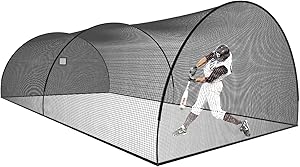
- Dimensions: 22x10x8 FT (also available in 30 FT length)
- Net Material: High-density polyester mesh with reinforced edges
- Frame Material: Heat-treated fiberglass poles
- Stability Features: Three sets of support ropes, six U-shaped ground stakes
The AIRHOP Portable Baseball & Softball Batting Cage offers an impressive blend of durability, stability, and user-friendliness, making it an excellent choice for backyard batting practice for players of all ages and skill levels. Its generous dimensions, particularly the 22x10x8 FT size (with a 30 FT option available), provide ample space for both hitting and pitching without feeling cramped. The construction utilizes high-density polyester mesh that is not only wear-resistant but also features heavy-duty reinforced edges. This robust netting is coupled with a frame made from heat-treated fiberglass poles, providing a strong yet flexible structure that contributes to its overall longevity.
Beyond its material quality, the AIRHOP cage shines in its practical design and ease of setup. The integrated design with elastic poles, along with a dual-eye adjuster for rope tension, allows two people to assemble the cage in approximately 20 minutes, which is remarkably fast for a structure of this size. Stability is further enhanced by three sets of support ropes and six U-shaped ground stakes. Thoughtful accessories like a removable cage door, a 12″ x 12″ pitching machine hole, a target cloth, and a convenient carrying bag complete the package. With a one-year product warranty and responsive customer support, this cage represents a reliable investment for serious backyard training.
- Pros:
- Highly durable polyester net and fiberglass frame
- Quick and easy two-person assembly (approx. 20 mins)
- Excellent stability with ropes and U-shaped stakes
- Cons:
- Requires two people for optimal setup
- May need additional weight in extremely high winds
2. Skywalker Sports 40 Foot Competitive Batting Cage

- Dimensions: 40 feet in length, 10-foot overhead clearance
- Frame Material: Heavy-duty, rust-resistant steel tubing
- Net Material: UV-protected batting cage netting
- Stability Features: Angled leg braces, weighs twice as much as competitors
The Skywalker Sports 40 Foot Competitive Batting Cage is engineered for serious athletes who demand durability and performance from their training equipment, whether practicing indoors or outdoors. Its substantial 40-foot length provides an authentic pitching and hitting environment, allowing for full swings and realistic ball flight trajectories. The construction is robust, featuring heavy-duty, rust-resistant steel tubing for the frame, which is built to withstand advanced hitters and diverse weather conditions, ensuring longevity and consistent performance year after year. The netting is also UV-protected, preventing degradation from sun exposure, a common issue with outdoor equipment.
A standout feature of this batting cage is its enhanced stability. Unlike many lighter alternatives, the Skywalker Sports cage incorporates angled leg braces, providing a significantly sturdier foundation that resists movement during intense practice sessions. This improved stability, combined with a frame that reportedly weighs twice as much as some competitors, ensures maximum strength and reliability. Furthermore, its collapsible design makes it a versatile option, allowing for year-round practice by easily transitioning from a backyard setup to an indoor training space during colder months. With a generous 10-foot overhead clearance, it accommodates high fly balls and ensures a comfortable, unrestricted practice environment for both baseball and softball players aiming to refine their skills.
- Pros:
- Extremely durable steel frame and UV-protected net
- Collapsible design for indoor/outdoor year-round use
- Enhanced stability with angled leg braces
- Cons:
- Heavier build may make relocation challenging
- Setup likely requires multiple people
3. ORIENGEAR Portable Baseball & Softball Batting Cage
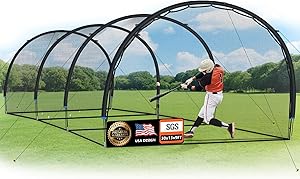
- Dimensions: 30ft (L) ×13ft (W)× 9ft (H)
- Net Material: Long-lasting polyester net with oxford cloth seams, 1-inch grid size
- Frame Material: High-strength 12.7mm fiberglass poles
- Applications: Suitable for baseball, softball, and golf
The ORIENGEAR Portable Baseball & Softball Batting Cage offers a versatile and robust training solution for athletes looking to improve their batting and pitching skills right in their backyard. Measuring a substantial 30ft in length, 13ft in width, and 9ft in height, this cage provides ample space for a full range of motion. The net is constructed from durable polyester with strong oxford cloth seams, designed to withstand the impact of powerful hits, while the 1-inch grid size effectively contains balls. High-strength 12.7mm fiberglass poles form the framework, contributing to the cage’s overall durability and ensuring it remains a staple in your training regimen for a long time.
One of the key benefits of the ORIENGEAR batting cage is its all-round protection, creating a dedicated and safe training space. The fully enclosed design prevents errant balls from causing damage or getting lost, allowing you to focus purely on your technique. Convenience is built-in, with one side of the net linked by buttons for easy entry and exit. While ideally suited for grass surfaces where ground stakes can be fully utilized for stability, it also offers solutions for concrete or indoor use with windproof ropes that can be secured to fixed objects or sandbags.
- Pros:
- Large dimensions provide ample practice space
- Durable polyester net and high-strength fiberglass poles
- All-round protection for safety and ball containment
- Cons:
- Requires securing methods for non-grass surfaces
- Setup might be more involved for a larger cage
4. ORIENGEAR Replacement Batting Cage Net (Frame Not Included)

- Dimensions: 35x10x10FT (also available in 20′, 55′, 70′ lengths)
- Net Material: High-quality PE material, UV stabilized
- Mesh Size: 1.88-inch mesh
- Features: Reinforced edges, side entry door, one-piece design with tethers
The ORIENGEAR Replacement Batting Cage Net offers a premium solution for those who already have a frame or are looking to build a custom batting cage system. Crafted from high-quality, UV-stabilized PE (polyethylene) material, this net is designed for exceptional durability and longevity, capable of withstanding both intense indoor and harsh outdoor conditions. The robust 1.88-inch mesh is highly effective at intercepting baseballs and softballs, while the knotted construction and reinforced edge design further enhance strength, preventing fraying and extending the net’s lifespan.
Designed for convenience, this one-piece net comes equipped with three long pull cords, two tethers, and an additional center roof tether, simplifying the installation process onto your existing frame. Its thoughtfully integrated side entry door, measuring 78.7 inches high by 31.5 inches wide, allows for easy and unobstructed access into and out of the cage, contributing to a more fluid training experience. When not in use, the door naturally sags and closes, preventing balls from escaping during practice. Available in various lengths, including the 35x10x10FT model, this net caters to different space requirements.
- Pros:
- High-quality, UV-stabilized PE material for durability
- Strong, knotted mesh with reinforced edges prevents fraying
- Convenient side entry door for easy access
- Cons:
- Frame and other accessories must be purchased separately
- Requires careful measurement for compatibility with existing frames
5. SHANTRA Portable Batting Cage with Frame and Net

- Dimensions: 13ft (L) x 13ft (W) x 9ft (H) (also available in 22ft and 30ft lengths)
- Net Material: Durable polyester mesh with oxford cloth seams, 1.25-inch mesh size
- Frame Material: 14mm high-strength fiberglass poles
- Stability Features: Windproof ropes, firm ground stakes, U-shaped nails
The SHANTRA Portable Batting Cage offers a reliable and convenient solution for baseball and softball enthusiasts of all levels to practice their hitting and pitching in the comfort of their backyard. Measuring 13ft (L) x 13ft (W) x 9ft (H), with larger sizes also available, this cage provides a suitable space for effective training. Its construction features a durable polyester mesh net with oxford cloth seams, engineered to withstand the strong impact of repeated hits without tearing easily. The frame is built with 14mm high-strength fiberglass poles, providing a robust yet flexible structure that contributes to the cage’s overall longevity and ability to endure rigorous use.
A key highlight of the SHANTRA batting cage is its enhanced stability, crucial for outdoor use in varying weather conditions. It comes equipped with windproof ropes and firm ground stakes, creating a solid and secure structure. The inclusion of U-shaped nails further boosts stability, helping to maintain the frame’s alignment during installation and use. Assembly is designed to be straightforward; with a clear, detailed instruction manual, 2-3 people can typically set up the cage in just 20-30 minutes, without needing additional tools.
- Pros:
- Durable polyester net and strong fiberglass frame
- Excellent stability with windproof ropes and ground stakes
- Relatively easy assembly with clear instructions
- Cons:
- Requires 2-3 people for installation
- Fiberglass poles may not be as rigid as steel alternatives
6. Heater Sports Home Run Batting Cage

- Dimensions: 12′ (L) x 12′ (W) x 10′ (H)
- Frame Material: Tubular steel legs
- Net Type: Portable net
- Machine Compatibility: Built-in machine square (machine not included)
The Heater Sports Home Run Batting Cage offers a compact yet effective solution for baseball and softball players of all ages looking to sharpen their skills in a dedicated practice space. With dimensions of 12′ x 12′ x 10′, it provides a manageable footprint that can fit in many backyards while still offering ample height for batting practice. The cage features a portable net combined with a durable frame constructed from tubular steel legs, ensuring a sturdy foundation for consistent training. The inclusion of rubber tips on the legs further enhances stability, providing a secure setup on various surfaces and helping to prevent movement during use.
A notable feature of this batting cage is its built-in machine square, which indicates compatibility and a designated safe area for a pitching machine (sold separately). This integration allows users to incorporate machine pitching into their regimen seamlessly, offering a consistent and challenging batting experience that can significantly improve reaction time and hitting mechanics. While the provided bullet points for this product on the original listing primarily detail a pitching machine’s features, the cage itself is designed to support and enhance such training.
- Pros:
- Compact footprint suitable for smaller backyards
- Durable tubular steel frame for stability
- Built-in pitching machine square for compatibility
- Cons:
- Smaller size might feel restrictive for advanced players
- Pitching machine is not included, an additional cost
7. Heater Sports PowerAlley Batting Cage

- Dimensions: 22 feet (L) x 12 feet (W) x 8 feet (H)
- Frame Material: Sturdy 1/2″ fiberglass rods
- Net Material: Durable 1″ nylon netting
- Safety Feature: Built-in pitching machine harness for external operation
The Heater Sports PowerAlley Batting Cage is a thoughtfully designed training system that prioritizes both player development and safety, making it an excellent choice for baseball and softball enthusiasts from young beginners to adults. Its spacious dimensions of 22 feet long, 12 feet wide, and 8 feet high provide an ample and realistic practice environment that can accommodate a full swing and allow for proper pitching distances. This generous space significantly enhances the training experience, simulating game-like conditions where a 50 MPH pitch from 46 feet feels like a much faster pitch in this setup, thereby improving reaction times and batting skills.
Constructed for durability and convenience, the PowerAlley cage features a robust frame made from sturdy 1/2″ fiberglass rods and employs durable 1″ nylon netting to withstand repeated impacts. The comprehensive package includes heavy-duty ground stakes to ensure stability during outdoor use. A standout safety feature is the built-in batting cage harness, which securely attaches any Heater Sports pitching machine, allowing it to operate from outside the cage. This design protects both the operator and the equipment, enhancing the safety of every practice session.
- Pros:
- Spacious dimensions for realistic training
- Built-in pitching machine harness enhances safety
- Quick and effortless setup and portability
- Cons:
- Pitching machine is not included, an extra expense
- Fiberglass frame may flex more than steel frames
How to Choose Home Batting Cages
For aspiring baseball and softball players, or even those looking to maintain their skills, a home batting cage represents a significant investment in personal development. The ability to practice hitting and pitching anytime, without the constraints of facility schedules or rental fees, offers unparalleled convenience and efficiency. A well-chosen batting cage transforms a backyard or open space into a dedicated training area, fostering consistent improvement and boosting confidence. However, with a variety of options on the market, selecting the perfect home batting cage can be a complex decision. This comprehensive guide is designed to walk you through the essential factors, helping you make an informed choice that aligns with your specific needs, budget, and available space.
Why a Home Batting Cage?
Investing in a home batting cage offers numerous benefits that extend beyond mere convenience. Firstly, it provides unrestricted access to practice, meaning you can train whenever you feel motivated, be it early morning or late evening. This consistent exposure to batting and pitching significantly accelerates skill development, building muscle memory and refining technique. Secondly, it’s a cost-effective solution in the long run, eliminating recurrent facility rental fees and travel expenses. Thirdly, a home setup offers a private, comfortable environment, free from the distractions or pressures of public facilities, allowing for focused, personalized training. Whether you’re working on swing mechanics, pitch accuracy, or simply staying sharp during the off-season, a home batting cage is an invaluable tool for any dedicated athlete.
Key Factors to Consider
Space & Size
The first and most critical consideration when choosing a home batting cage is the available space. You need to accurately measure the area where you intend to set up the cage, both for length, width, and height. Remember to account for extra clearance around the cage for safety and comfortable movement.
Available Space
Consider whether you’re setting up in a backyard, a garage, or an indoor sports area. Backyard installations need to account for uneven terrain, drainage, and proximity to fences, windows, or other structures. Indoor setups require precise measurements to ensure the cage fits without touching walls or ceilings, potentially limiting your swing. Always add a few feet of buffer space to your measurements.
Cage Dimensions
Batting cages come in a range of sizes. Length is crucial, as it dictates the simulated distance between the pitcher and batter, and provides enough room for ball flight. Typical lengths range from 20 feet for youth or small spaces, up to 70 feet for more professional, game-like experiences. Width needs to accommodate a full swing comfortably, often 10-14 feet. Height is equally important to catch pop-ups and prevent balls from exiting the cage, generally ranging from 8-12 feet. Match these dimensions to the age and skill level of the primary users – younger players might suffice with smaller cages, while advanced players will need more expansive setups for realistic training.
Frame Material & Durability
The frame is the skeletal system of your batting cage, and its material directly impacts the cage’s durability, stability, and lifespan.
Steel vs. Fiberglass
Steel frames offer superior strength and rigidity, making them ideal for permanent or heavy-use setups. They can withstand stronger impacts and harsher weather, but are heavier, more expensive, and typically require more effort to assemble and disassemble. Fiberglass poles, often seen in portable cages, are lighter, more flexible, and easier to transport and set up. While durable, they may not offer the same level of impact resistance as steel and can be prone to bending or snapping under extreme stress. Your choice will depend on your usage frequency, budget, and need for portability.
Weather Resistance
For outdoor cages, weather resistance is paramount. Look for steel frames with rust-resistant coatings (galvanized or powder-coated) and fiberglass poles that are treated to resist UV degradation. The frame’s stability is also critical, especially in windy conditions. Features like strong ground stakes, guy lines, and angled leg braces significantly enhance the cage’s ability to remain upright and secure. A robust, well-anchored frame prevents swaying and potential collapse, ensuring a safer and more consistent practice environment.
Netting Quality & Mesh Size
The netting is what contains the balls and absorbs the impact of hits, so its quality and specifications are vital for both safety and longevity.
Material
Batting cage nets are commonly made from nylon, polyester, or polyethylene (PE). Nylon is known for its strength, elasticity, and excellent abrasion resistance, making it highly durable against high-speed impacts. Polyester offers good strength and is less prone to stretching than nylon, often with good UV resistance. PE nets are typically lighter and highly resistant to moisture and UV radiation, making them a popular choice for outdoor use due to their weather resilience and cost-effectiveness. The thickness of the twine (often measured in number of strands, e.g., #21, #36, #42) indicates its strength – higher numbers mean thicker, stronger netting, suitable for more powerful hitters.
Mesh Size
Standard mesh sizes for baseball and softball cages are typically 1.5 to 1.88 inches (4 to 5 cm) square. This size is small enough to contain regulation-sized balls effectively while providing good visibility. For multi-sport use, such as golf, a slightly larger mesh might be acceptable, but for serious baseball/softball training, a smaller mesh offers better containment. Ensure the mesh is knotted, as this adds strength and prevents unraveling compared to knotless nets. UV stabilization is essential for outdoor nets to prevent degradation and weakening from prolonged sun exposure. Also, look for reinforced edges and seams, as these areas experience significant stress and are crucial for the net’s overall lifespan.
Portability vs. Permanent Setup
Decide whether you need a cage that can be moved or stored, or one that will remain in place year-round.
Portable Cages
These are designed for easy assembly, disassembly, and transportation. They typically feature lighter fiberglass frames and come with carrying bags. Portable cages are ideal for seasonal use, smaller backyards, or if you need to share the space for other activities. Their ease of setup (often 20-30 minutes with two people) makes them convenient, though they might be less robust than permanent structures.
Permanent Cages
Usually built with heavy-duty steel frames, these cages are meant to be a semi-permanent fixture in your yard or training facility. They offer superior stability and durability, making them suitable for intense, regular use by advanced players. While their installation is more involved and they require a dedicated space, they provide a reliable, long-term training solution.
Ease of Assembly
Consider how much time and effort you’re willing to invest in setting up the cage. Some portable models can be erected by one or two people in under an hour, while larger, more complex permanent cages might require multiple people and several hours, or even professional installation. Look for clear, step-by-step instructions and minimal tools required. Integrated designs and elastic poles simplify the process considerably.
Budget
Home batting cages vary widely in price, from a few hundred dollars for basic portable models to several thousands for commercial-grade permanent setups. Establish a realistic budget and consider it an investment in athletic development. Remember that higher quality materials and larger sizes generally come with a higher price tag. Factor in potential additional costs for pitching machines, target screens, or ground anchors if they are not included.
Additional Features
Pitching Machine Compatibility
Many cages come with a pitching machine hole or a built-in harness to safely position a pitching machine outside the cage. This is a highly recommended feature for consistent pitch delivery and enhanced training.
Target Screens
An integrated or optional target screen at the back of the net can help improve pitching accuracy and provide a clear focal point for hitters.
Entry/Exit Points
Convenient entry and exit via zippered doors or button-linked sections enhance the user experience, making it easier to retrieve balls and move in and out of the cage.
Storage Bags
For portable models, a durable carrying bag is essential for easy transport and organized storage.
Safety Considerations
Always prioritize safety. Ensure the cage is properly installed and anchored according to manufacturer instructions. Regularly inspect the netting for tears, holes, or weak spots, and the frame for any damage or loose connections. Keep the area around the cage clear of obstacles, and always supervise younger players. Proper safety protocols minimize risks and maximize training benefits.
Maintenance Tips
To extend the life of your batting cage, regular maintenance is key. Clean the net periodically to remove dirt, leaves, and debris. For outdoor cages, consider taking down portable models during extreme weather conditions or the off-season to protect them from unnecessary wear and tear. Store nets and frames in a dry, protected area. Regularly check all connections, stakes, and ropes for wear and tear, replacing damaged components as needed.
Conclusion
Choosing the best home batting cage involves balancing your available space, budget, desired durability, and specific training needs. By carefully considering frame materials, netting quality, size, and additional features, you can select a cage that will provide countless hours of effective practice. An informed decision ensures a safe, efficient, and enjoyable training environment that supports long-term skill development and helps you reach your full athletic potential right in your own backyard.