
Best Honey Extractors For Beginners of 2026
For beginners, choosing the right honey extractors can feel daunting, with various models offering different features, capacities, and levels of automation. This comprehensive guide simplifies the selection process, highlighting the best honey extractors designed with novice beekeepers in mind. We’ll explore crucial factors like frame capacity, construction material, manual versus electric operation, and ease of use. Get ready to spin your way to golden success!
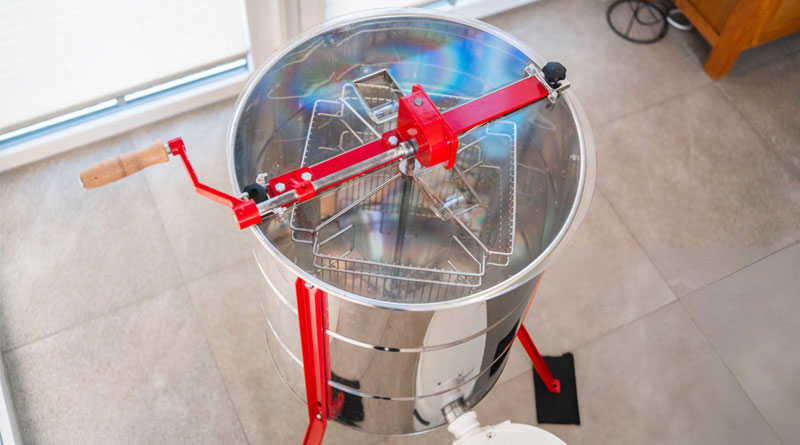
1. VEVOR Manual Honey Extractor

* Frame Capacity: Fits 3 deep, medium, or shallow frames
* Material: Rust-resistant polished stainless steel
* Adjustable Height: Range of 39.3 to 42.5 inches
* Honeycomb Sizes: Deep (18.9 x 9 in) and Medium (18.9 x 6.3 in)
The VEVOR Manual Honey Extractor is an excellent choice for hobbyist beekeepers who prefer a hands-on approach to their harvest. Its durable stainless steel construction ensures a hygienic environment for your honey while remaining remarkably easy to clean after a long day in the apiary. The ergonomic hand crank is designed to minimize physical strain, allowing you to spin frames with precision and care to keep your wax combs intact for future use.
One of the standout features of this model is its stability and visibility. The adjustable legs allow you to find the perfect working height and can be bolted down to prevent the wobbling often associated with manual spinning. Additionally, the clear lid is a fantastic touch, providing a front-row seat to the extraction process so you can monitor progress without stopping. It is a reliable, stylish, and efficient tool for any small-scale honey production.
- Pros:
- Durable and rust-resistant stainless steel body
- Adjustable height for better ergonomics and easier draining
- Clear lid allows for easy monitoring of the extraction process
- Cons:
- Manual operation requires physical effort for larger harvests
- May require bolting to a base for maximum stability during fast spins
2. GOODLAND BEE SUPPLY Hardin Professional Manual
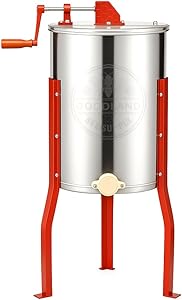
- Tank Material: 16 gauge stainless steel
- Gear Construction: Steel gear with sealed bearings
- Lid: Clear Plexiglas top
- Stand: Optional leg/stand included
The GOODLAND BEE SUPPLY Hardin Professional 2 Frame Manual Honey Extractor is an excellent entry-level option for aspiring beekeepers seeking a robust and straightforward solution. Its construction boasts a durable 16 gauge stainless steel tank, ensuring longevity and hygienic handling of your precious honey. The steel gear construction, paired with sealed bearings, provides a smooth and efficient manual cranking experience, minimizing effort while maximizing honey extraction.
This extractor is designed with convenience in mind, offering an optional leg/stand that makes draining honey simple and keeps the drum at a comfortable working height. Its two-frame capacity is perfect for hobbyists or those with a small number of hives, ensuring you don’t overcommit to a larger, more complex machine before gaining experience.
- Pros:
- Durable stainless steel construction
- Smooth and efficient manual operation
- Clear lid for process monitoring
- Cons:
- Manual operation requires effort
- Limited to 2 frames per batch
3. VEVOR Electric Honey Extractor (2/4 Frame)
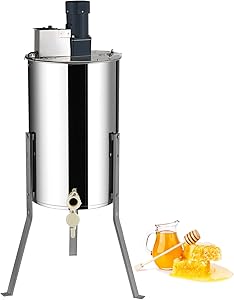
- Frame Capacity: 2 deep or 4 shallow/medium frames
- Motor Power: 140W with adjustable speed (up to 1300 rpm)
- Material: Polished stainless steel
- Stand: Adjustable height (39.3” – 42.5”), bolt-down legs
The VEVOR Electric Honey Extractor (2/4 Frame) offers a significant upgrade for beginners looking for efficiency and reduced physical effort in their honey harvesting. With its versatile capacity, it can comfortably handle either two deep frames or up to four shallow/medium frames, making it suitable for varying hive setups. The powerful 140W electric motor is a game-changer, eliminating manual cranking and allowing you to adjust the spinning speed up to 1300 rpm.
Crafted from polished stainless steel, this extractor is not only aesthetically pleasing but also highly durable and rust-resistant, simplifying cleanup and ensuring years of reliable use. The design focuses on stability and convenience, featuring an adjustable stand that allows you to set the working height to your preference and legs that can be bolted down for extra security, preventing unwanted shaking during operation. A clear lid provides excellent visibility of the extraction process, and a crucial safety feature automatically stops the motor if the lid is opened, offering peace of mind.
- Pros:
- Electric motor for effortless extraction
- Versatile 2/4 frame capacity
- Durable, polished stainless steel
- Cons:
- Higher initial cost than manual models
- Requires an electrical outlet
4. Honey Lake Electric Honey Extractor

- Frame Capacity: 3 medium, shallow, or deep frames
- Motor: 140W, 90–1250 rpm (low-noise, adjustable)
- Material: Seamless stainless steel barrel
- Stand: Height-adjustable (36.8” to 40.8”), triangular leg design
The Honey Lake 3 Frame Electric Honey Extractor hits a sweet spot for beginners and hobbyists seeking a balance between capacity and convenience. Its ability to hold up to three deep, medium, or shallow frames simultaneously makes it highly adaptable for various beekeeping operations, allowing for a more efficient harvest compared to smaller 2-frame units. The heart of this extractor is its low-noise 140W motor, offering adjustable speeds from 90 to 1250 rpm.
Durability and hygiene are paramount, and the Honey Lake extractor delivers with a seamless stainless steel barrel design that is both long-lasting and easy to clean. The transparent plexiglass lid is a fantastic feature, allowing you to safely observe the honey extraction without interrupting the process. Furthermore, the height-adjustable stand, featuring a stable triangular leg design, accommodates various bucket sizes up to 5 gallons and ensures a comfortable working posture, minimizing strain.
- Pros:
- Versatile 3-frame capacity
- Quiet, adjustable electric motor
- Excellent safety features (auto-stop)
- Cons:
- Only 3 frames, not ideal for larger apiaries
- Requires power outlet
5. VEVOR Electric Honey Extractor (3 Frame)

- Frame Capacity: 6 medium frames
- Motor Power: 140W with stepless speed adjustment (0-100 RPM)
- Bottom Design: Patented conical sloped base
- Stand: Adjustable height (26-33.8 inches)
The VEVOR Electric Honey Extractor (6 Frame) represents a leap in efficiency for beginner beekeepers whose operations are starting to expand. Capable of processing six medium frames simultaneously, it offers a significant time-saving advantage over smaller models, ideal for those with a growing number of hives or simply wanting to get their harvest done faster. Despite its larger capacity, it boasts a space-saving design, ensuring it doesn’t overwhelm smaller workspaces. A key innovation is its patented conical sloped base, which naturally guides honey towards the bottom outlet.
Powering this efficient extractor is a 140W motor featuring stepless speed adjustment, allowing for fine-tuned control over the spin from 0-100 RPM. This adaptability is crucial for handling honey of varying viscosities and preserving the integrity of the honeycombs, ensuring optimal honey yield every time. The adjustable legs, ranging from 26 to 33.8 inches, accommodate diverse workstations and user heights, providing an ergonomic experience that reduces back strain. To top it off, the impact-resistant, UV-resistant PC transparent lid allows for real-time monitoring of the extraction, promising durability and safety even with frequent outdoor use.
- Pros:
- High 6-frame capacity for efficiency
- Innovative conical bottom for minimal waste
- Stepless speed adjustment for precision
- Cons:
- Primarily for medium frames
- Requires more storage space than 2-frame models
6. VINGLI Manual Honey Extractor

- Material: Food-grade polished stainless steel
- Frame Capacity: 2 standard deep, medium, or shallow frames
- Crank Design: Upgraded handle with square screw dent
- Stand: Height-adjustable legs, removable for tabletop use
The VINGLI 2 Frames Manual Honey Extractor is an excellent choice for beginner beekeepers who prefer a hands-on approach and appreciate sturdy, reliable equipment. Crafted from top-grade, food-grade polished stainless steel, this extractor is built to resist rust and abrasion, ensuring long-lasting durability and maintaining the purity of your honey. The barrel features a sleek finish and seamless welding, making it incredibly easy to clean with just soap and water after each use.
A standout feature is the upgraded manual crank handle, which includes a square screw dent for secure installation, making it easier to operate. The solid metal crank turns smoothly and efficiently, providing effective honey extraction ideal for both household and smaller commercial beekeepers. Versatility is enhanced by the height-adjustable legs, which can accommodate various bucket sizes underneath the extractor. These legs can also be bolted to the floor for added stability or entirely removed for convenient tabletop use, catering to different setup preferences.
- Pros:
- Durable, food-grade stainless steel
- Versatile 2-frame capacity
- Upgraded, easy-to-use manual crank
- Cons:
- Manual operation requires physical effort
- Limited to 2 frames per batch
7. BeeCastle Manual Honey Extractor
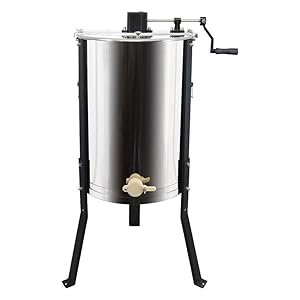
- Drum Material: High-quality stainless steel
- Frame Capacity: 2 standard deep, medium, or shallow frames
- Handle: Ergonomic manual crank
- Design: 2 carry handles, two transparent lids, height adjustable (37″-41″)
The BeeCastle Manual Honey Extractor (2 Frame) is a superb option for new beekeepers who prioritize simplicity, durability, and hands-on control. Constructed from high-quality stainless steel, the drum is built to resist rust and wear, promising a long lifespan and ensuring hygienic honey processing. This robust material also makes cleaning exceptionally easy, a significant advantage for beginners.
Designed with user comfort in mind, the manual crank features an ergonomic handle that is easier to grip and less prone to slipping, making the extraction process less laborious and more efficient. The extractor’s height is also adjustable, ranging from 37″ to 41″, allowing you to customize your working height for optimal comfort and to accommodate various honey collection buckets. Thoughtful design touches include two carry handles for easy portability and two transparent lids that let you safely observe the spinning process, adding an element of engagement and control.
- Pros:
- Durable stainless steel construction
- Ergonomic manual crank for comfort
- Height-adjustable stand
- Cons:
- Manual operation requires effort
- Limited 2-frame capacity
How to Choose Honey Extractors For Beginners?
Embarking on the journey of beekeeping is a fulfilling endeavor, culminating in the sweet reward of fresh honey. However, collecting that honey efficiently requires the right equipment, and a honey extractor is arguably the most crucial tool in your apiary. For beginners, the process of selecting an extractor can seem overwhelming, given the variety of options available. This guide aims to demystify the choices, helping you pick an extractor that suits your needs, budget, and comfort level, ensuring your first few harvests are as enjoyable as they are productive.
Understanding Honey Extractors
A honey extractor is a mechanical device used to separate honey from honeycombs without damaging the comb. This allows beekeepers to reuse the combs, saving bees the energy and resources required to build new ones. Extractors work on the principle of centrifugal force: frames of uncapped honey are placed inside a drum, which is then spun at high speed. The honey flies out of the cells, hits the sides of the drum, and flows down to an outlet at the bottom, where it can be collected. There are several types, each with specific advantages.
Types of Honey Extractors for Beginners
For beginners, the primary distinction often lies between manual and electric extractors, and radial versus tangential designs. Understanding these differences will guide your initial decision.
Manual vs. Electric
- Manual Honey Extractors: These extractors are operated by hand-cranking a handle that spins the frames. They are typically more affordable, simpler in design, and don’t require an electrical power source, making them ideal for small-scale beekeepers or those with a limited number of hives (1-5 hives). While they require more physical effort, they offer a direct, hands-on experience and are less prone to mechanical failures. Many beginners start with a manual two-frame extractor, as it’s a cost-effective way to get started without a large upfront investment.
- Electric Honey Extractors: Powered by a motor, electric extractors eliminate the need for manual cranking. They offer convenience, faster extraction, and consistent spinning speeds, reducing physical exertion. While more expensive, they are a worthwhile investment for beekeepers with a growing number of hives (5+ hives) or those who anticipate future expansion. Electric models often come with adjustable speed settings, providing greater control over the extraction process and minimizing damage to delicate combs.
Tangential vs. Radial
- Tangential Extractors: In a tangential extractor, the frames are positioned with one side facing the drum wall. This means only one side of the comb is extracted at a time, requiring you to stop the machine, flip the frames, and then extract the other side. While less efficient in terms of time, they are effective for thicker honey and can handle various frame sizes. Many 2-frame extractors are tangential.
- Radial Extractors: Radial extractors position the frames like spokes on a wheel, with the top bar facing outward. This allows both sides of the comb to be extracted simultaneously as the honey is spun out from the center. This design is much more efficient, as it eliminates the need to flip frames, saving considerable time and effort. Radial extractors are generally larger, accommodate more frames, and are often electric. While a 6-frame radial electric extractor might be an aspiration, a 3 or 4-frame electric unit can still offer radial benefits for beginners with a slightly larger apiary.
Key Factors to Consider When Choosing
Frame Capacity
This is perhaps the most important consideration for a beginner. A 2-frame extractor is perfect for 1-2 hives, allowing you to process a small harvest efficiently. If you plan to expand to 3-5 hives in the near future, a 3-frame or 4-frame extractor might be a better long-term investment. Larger extractors (6+ frames) are generally more suited for commercial operations, but smaller radial versions can still be beneficial for dedicated hobbyists. Consider your current number of hives and your future beekeeping goals.
Material and Construction
The vast majority of honey extractors are made from stainless steel, which is ideal because it’s food-grade, rust-resistant, easy to clean, and durable. Look for extractors with a gauge of at least 16 gauge stainless steel for the tank, as this indicates good durability. Seamless welding is also a plus, as it prevents leaks and makes cleaning easier. Components like gears should also be robust, preferably steel, with sealed bearings for smooth operation and longevity.
Ease of Cleaning
After the sticky work of extraction, cleaning is inevitable. Look for designs with smooth interiors, minimal crevices, and a well-placed honey gate (spigot) that allows for complete drainage. Stainless steel is inherently easy to sanitize. Some models feature conical bottoms that naturally direct honey to the outlet, further simplifying cleanup.
Stability and Portability
An extractor needs to be stable during operation to prevent tipping or excessive shaking. Many models come with legs that can be bolted to the floor or a piece of plywood for added security. Adjustable legs are a great feature, allowing you to set the working height comfortably and accommodate different sizes of honey collection buckets. If you need to move your extractor frequently, consider models with integrated handles or a lighter overall design, though heavy-duty construction often means more weight.
Safety Features
Especially for electric models, safety is paramount. Look for features like a clear lid that allows you to observe the process without exposing yourself to spinning parts. Some electric extractors have an automatic shut-off mechanism if the lid is opened during operation, which is an excellent safety measure for preventing accidents. Manual extractors should have sturdy, non-slip handles.
Lid Design
A transparent lid, typically made from Plexiglas or clear polycarbonate, is highly beneficial. It allows you to monitor the extraction progress, ensuring all honey has been spun out and that your combs are not being damaged. Clear lids also keep debris out of your honey during the process.
Budget
As a beginner, you’ll want to balance cost with functionality. Manual 2-frame extractors are the most budget-friendly option, typically ranging from $150-$300. Electric 2-4 frame models will generally cost more, from $300-$600, while larger electric radial extractors can go higher. Define your budget early, but remember that investing in a slightly better extractor upfront can save you headaches and replacement costs down the line.
Manual vs. Electric: Which is Right for You?
The decision between manual and electric often comes down to personal preference and the scale of your operation:
- Choose Manual if: You have 1-3 hives, a limited budget, prefer a simpler machine, don’t mind a bit of physical effort, or want an extractor that doesn’t rely on electricity.
- Choose Electric if: You have 3+ hives (or plan to expand), prefer convenience and speed, have a larger budget, want adjustable speed control, or want to reduce physical strain during harvest.
Maintenance and Storage
Regardless of the type you choose, proper maintenance will extend the life of your extractor. Always clean the extractor thoroughly with warm soapy water immediately after use to prevent honey from hardening and becoming difficult to remove. Store it in a clean, dry place to prevent rust and protect it from dust and pests. Inspect gears and bearings periodically for wear and lubrication if necessary.
Conclusion
Selecting the best honey extractor as a beginner is a decision that impacts the enjoyment and efficiency of your beekeeping journey. By considering factors such as frame capacity, construction materials, the choice between manual and electric operation, and important design features like stability and ease of cleaning, you can confidently choose an extractor that perfectly aligns with your current needs and future aspirations. Starting with a reliable, user-friendly extractor ensures that your first honey harvests are not just productive, but truly a sweet success.