Best Refractometers For Honey of 2026
For beekeepers and honey enthusiasts alike, understanding the quality of honey goes beyond taste. A crucial aspect is its moisture content, which directly impacts shelf life, fermentation risk, and overall grade. This is where a high-quality refractometer becomes an indispensable tool. This guide will help you navigate the options, highlighting the best refractometers available for reliable honey analysis.
1. Aichose Honey Refractometer

- Measuring Range: 58-90% Brix, 38-43 Be’, 12-27% Water
- Resolution: 0.5% Brix, 0.25 Be’, 0.5% Moisture
- Temperature Compensation: Automatic (ATC) feature included
- Power Source: Manual operation with no batteries required
The Aichose Honey Refractometer is a specialized 3-in-1 tool that offers a comprehensive look at honey quality by measuring Brix, Baume, and moisture levels simultaneously. Its portable design and lightweight 3.2-ounce build make it an essential companion for beekeepers in the field. By utilizing ambient light and a high-quality prism, this device provides clear, readable scales without the need for external power.
The integration of Automatic Temperature Compensation is a standout feature, ensuring that fluctuations in environment do not skew your data. This makes it highly reliable for agricultural and educational settings where precision is key. The durable construction feels solid in the hand, and the simple calibration process ensures that even beginners can achieve professional-grade results quickly. It is an efficient, low-maintenance solution for monitoring honey ripeness.
- Pros:
- Provides three essential honey metrics in a single view.
- ATC ensures accuracy across varying environmental temperatures.
- Requires no batteries, making it eco-friendly and reliable.
- Cons:
- Scale can be difficult to read in very low-light conditions.
- Manual calibration is required before the first use.
2. ZffXH 3-in-1 Honey Refractometer

- Measurement Scales: Brix (58-90%), Baume (38-43%), Moisture (10-33%)
- ATC Range: 10 to 30°C
- Optical Feature: High-definition prism
- Min Scale: 1% Moisture, 1% Brix, 0.5% Baume
The ZffXH 3-in-1 Honey Refractometer stands out as a professional-grade instrument offering precise measurements for beekeepers and syrup producers. This robust device simultaneously evaluates Brix (sugar content), Baume, and moisture content, providing a comprehensive analysis of honey, maple syrup, and molasses. Its measuring range of 58-90% Brix, 38-43% Baume, and 10-33% moisture content, coupled with distinct minimum scale divisions, ensures highly accurate readings crucial for quality control and optimal product processing.
A key feature enhancing its reliability is the Automatic Temperature Compensation (ATC) system, specifically calibrated to maintain accuracy within an ambient temperature range of 10 to 30°C. This means that once calibrated at 20°C, the device provides consistent results without the need for constant manual temperature adjustments, which is vital for maintaining product quality in varying environmental conditions. The inclusion of a high-definition prism further contributes to clear data visibility, making readings straightforward and reducing potential for error.
- Pros:
- Professional 3-in-1 measurement for key honey parameters
- High-definition prism ensures clear and easy-to-read scales
- Effective Automatic Temperature Compensation (ATC) within practical range
- Cons:
- Requires specific calibration solutions (not pure water)
- Manual optical reading might be challenging for some users
3. Nuogo 2 Pack Brix Meter Refractometer

- Measurement Scales: Moisture (12-27%), Brix (58-90%), Baume (38-43)
- Pack Quantity: 2 refractometers
- Division: 0.5% Water, 0.5% Brix, 0.25% Baume
- Application: Honey, maple syrup, molasses, fruit, sugary drinks
The Nuogo 2 Pack Brix Meter Refractometer offers an exceptional value proposition, providing two robust 3-in-1 instruments ideal for accurately assessing the quality of honey and various other sugary liquids. Each refractometer is designed to simultaneously measure honey moisture, Brix (sugar content), and Baume, giving users a comprehensive understanding of their product’s composition.
These refractometers come pre-calibrated from the factory, making them incredibly easy to use right out of the box. A simple process involves applying a small sample onto the prism and reading the scale through the eyepiece, providing quick and reliable results for honey, milk, vegetable oils, sugar syrups, fruit jams, and molasses. Beyond ease of initial use, the sturdy and portable design guarantees durability and convenient transport, making them suitable for frequent field use or laboratory settings.
- Pros:
- Excellent value with a convenient 2-pack
- Measures three crucial honey parameters (3-in-1)
- Pre-calibrated for immediate use
- Cons:
- Recalibration requires glycerol, not just water
- Manual optical reading may not suit all users
4. Atago PAL-22S Digital Honey Refractometer

- Type: Digital Hand-Held Pocket Refractometer
- Moisture Range: 12.0 to 30.0%
- Temperature Range: 10.0 to 40.0°C
- Protection Rating: IP-65 (dust and water jet resistant)
The Atago PAL-22S Digital Hand-Held Pocket Honey Refractometer represents a significant step up in convenience and precision for honey moisture testing. Unlike traditional optical models, this digital device eliminates the need for manual interpretation of scales, providing a clear, LED-illuminated numerical display of the moisture content. It’s specifically designed for measuring honey moisture within a range of 12.0 to 30.0%, crucial for determining honey quality and preventing fermentation.
A standout feature is its Automatic Temperature Compensation (ATC) system, which functions effectively across a broad temperature range of 10.0 to 40.0°C, ensuring consistent and accurate readings regardless of the ambient temperature. Furthermore, the innovative External Light Interference (ELI) feature alerts the user if outside light is affecting the measurement, safeguarding against unreliable results.
- Pros:
- Digital display offers easy and unambiguous readings
- Automatic Temperature Compensation ensures high accuracy
- External Light Interference (ELI) feature prevents reading errors
- Cons:
- Primarily measures only moisture, not Brix or Baume
- Higher cost compared to many optical refractometers
5. LOHAND Honey & Brix Refractometer
- Brix Scale Range: 0-90%
- Resolution: 0.5% Brix
- Construction: Chromium and copper main body
- Feature: Automatic Temperature Compensation
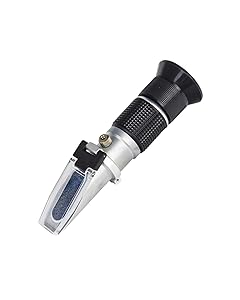
The LOHAND Honey Refractometer is a specialized tool designed for precise measurement of sugar concentration in a wide array of liquids, particularly honey, syrups, fruits, and beverages. Its impressive 0-90% Brix scale range makes it highly versatile, catering not only to honey producers but also to those involved in maple syrup, wine, fruit juice, and even cutting fluid analysis. This broad measuring capability, coupled with a fine resolution of 0.5% Brix, ensures consistently accurate readings, allowing users to quickly and reliably assess the quality of their products with minimal effort.
Crafted with a main body made from chromium and copper, this refractometer boasts exceptional durability and resistance to wear and corrosion, making it suitable for regular use and capable of enduring exposure to general corrosive liquids. High-quality optical components, including high-refractive-index lenses, form a precision optical system that ensures smooth focusing and clear, dependable results. Based on the principle that a liquid’s refractive index changes with its concentration, it only requires a few drops of liquid for an accurate reading.
- Pros:
- Exceptionally wide 0-90% Brix scale range
- High precision with 0.5% Brix resolution
- Durable construction from chromium and copper for longevity
- Cons:
- Primarily focuses on Brix, not specific honey moisture/Baume
- Optical reading requires good lighting and clear eyesight
6. Vee Gee Scientific HMX-1 Premium Honey Refractometer

- Scales: Triple (Moisture: 13-27%, Brix: 58-92%, Baume: 38-43°)
- Grip: Tactical, non-slip rubber grip
- Prism Housing: All-metal
- Warranty: 5-Year
The Vee Gee Scientific HMX-1 Premium Honey Refractometer is an industrial-grade instrument designed for beekeepers and food professionals who demand superior accuracy and durability. This device features a crucial triple scale, allowing for simultaneous measurement of honey moisture (13-27%), Brix (58-92%), and Baume (38-43°). The large, sharp display scales with high contrast ensure easy and unambiguous readings, reducing eye strain and improving efficiency during prolonged use.
Beyond its optical excellence, the HMX-1 is engineered for robust performance and user comfort. It incorporates a tactical, non-slip rubber grip on the body, which not only provides a secure hold but also effectively blocks the transmission of hand heat, minimizing temperature effects on the readings. The prism itself is encased in an all-metal housing, a design choice that allows both the sample and the prism to reach temperature equilibrium quickly, further enhancing the accuracy and speed of measurements.
- Pros:
- Triple scale measurement for comprehensive honey analysis
- Large, sharp, high-contrast scales for easy reading
- High-quality optical glass ensures consistent accuracy
- Cons:
- Higher price point due to premium, industrial-grade features
- Manual optical reading method
7. TRZ Honey Refractometer for Beekeeping

- Measuring Ranges: 10-32% Water, 58-90% Brix
- Resolution: 0.2% Water, 0.2% Brix
- Calibration: Specific 65% Brix solution (not water)
- Optical Quality: Sharp dividing line, adjustable eyepiece
The TRZ Refractometer Honey is a precise and user-friendly instrument designed for the accurate measurement of honey quality, as well as other high-sugar content liquids like condensed milk, sugar syrup, fruit jam, and molasses. This versatile tool provides essential data on Brix (sugar concentration), water content, and Baume, enabling beekeepers and food producers to ensure their products meet desired standards.
One of the standout features of the TRZ refractometer is its innovative calibration method, which involves using a colorless, non-toxic calibration solution with a 65% Brix concentration and a slight clove smell. This advanced method ensures precise and convenient calibration, directly correlating the Brix percentage to an accurate honey moisture value, thus eliminating the need for subsequent corrections to the moisture reading.
- Pros:
- Measures three crucial honey parameters (Water, Brix, Baume)
- High precision with 0.2% resolution for water and Brix
- Innovative and accurate calibration method tailored for honey
- Cons:
- Requires a specific calibration solution, not just pure water
- Manual optical reading may require good lighting and steady hands
How to Choose Refractometers For Honey
For beekeepers, honey producers, and even home enthusiasts, understanding the quality of honey is paramount. Beyond its delightful taste, characteristics like moisture content significantly impact honey’s stability, shelf life, and susceptibility to fermentation. This is where a honey refractometer becomes an indispensable tool. A refractometer is a precision optical instrument that measures the refractive index of a substance, which can then be correlated to its concentration, specifically sugar content (Brix), moisture, and often Baume scale in honey. Choosing the right refractometer can seem daunting with the variety of options available. This comprehensive guide will walk you through the essential factors to consider, ensuring you select the best instrument for your honey analysis needs.
Why You Need a Honey Refractometer
The importance of accurate honey measurement cannot be overstated. A refractometer provides objective data that empowers beekeepers to make informed decisions at various stages of honey production.
Ensuring Quality and Purity
Honey’s quality is largely determined by its moisture content. Honey with high moisture (typically above 18-20%) is prone to fermentation, where yeasts convert sugars into alcohol and then acetic acid, leading to spoilage. A refractometer helps you verify that your honey’s moisture content is within the optimal range (usually below 18%), ensuring a stable, high-quality product that won’t spoil prematurely. It also helps assess sugar concentration, which is a key indicator of ripeness and overall quality.
Optimizing Harvest Time
Knowing when honey is ripe and ready for harvest is crucial. Bees naturally reduce the moisture content of nectar to transform it into honey. Capped honey typically indicates a moisture level below 18%. A refractometer allows beekeepers to test uncapped honey or even cappings to gauge the moisture content precisely, preventing premature harvesting of watery honey or, conversely, letting it sit too long. This optimization ensures maximum yield of high-quality, stable honey.
Meeting Standards
Whether you’re selling commercially or just to friends and family, meeting certain quality standards is important. Many regulatory bodies and honey associations specify maximum moisture content for honey. Using a refractometer ensures your honey adheres to these guidelines, building trust with consumers and avoiding potential issues related to product quality.
Types of Refractometers for Honey
Refractometers primarily come in two types, each with its own advantages and disadvantages.
Optical (Analog) Refractometers
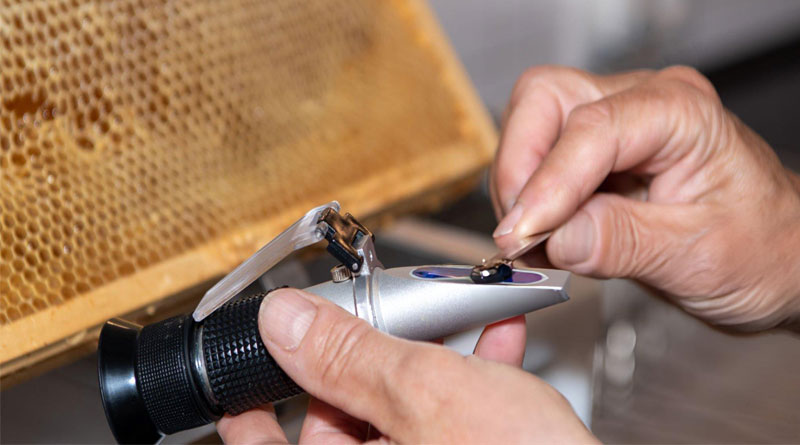
These are the most common and often most affordable type. They require a small sample of honey placed on a prism, which is then viewed through an eyepiece. Light passes through the sample, and the refractive index causes a shadow line to appear against a graduated scale. The user reads the measurement where the shadow line crosses the scale. Optical refractometers are durable, don’t require batteries, and are great for field use. However, they rely on subjective reading and good lighting conditions.
Digital Refractometers
Digital refractometers take a sample and display a precise numerical reading on an LCD screen. They use internal light sources and sensors to determine the refractive index, converting it to a direct reading of Brix, moisture, or Baume. While generally more expensive, they offer greater accuracy, eliminate subjective reading errors, and often include features like automatic temperature compensation and external light interference alerts. They are ideal for high-volume operations or those requiring the highest level of precision and ease of use.
Key Features to Look For
When selecting a honey refractometer, several features can significantly impact its performance and suitability for your needs.
Measurement Scales (Brix, Moisture, Baume)
The best honey refractometers typically offer multiple scales: Brix (sugar concentration), water content (moisture), and Baume. A 3-in-1 model provides the most comprehensive data, allowing you to assess honey quality from several angles without needing multiple devices. Ensure the ranges for each scale match typical honey values.
Automatic Temperature Compensation (ATC)
Temperature affects the refractive index of liquids. A refractometer without ATC would require you to manually adjust your readings based on temperature charts, which is cumbersome and prone to error. ATC automatically corrects the reading to a standard temperature (usually 20°C), ensuring accurate results even when testing honey at varying ambient temperatures. This is a crucial feature for reliability.
Accuracy and Resolution
Look for refractometers with a high degree of accuracy and fine resolution. For moisture content, a resolution of 0.2% or 0.5% is generally good. Higher accuracy means more trustworthy results, which is essential for consistent honey quality. Digital models often boast higher precision.
Durability and Materials
Refractometers are often used in the field or in processing areas. Choose a model made from robust materials like aluminum alloy or high-grade ABS resin. Features like an all-metal prism housing and an IP rating (e.g., IP65 for dust and water jet resistance) indicate a durable device that can withstand demanding conditions and offer longevity.
Ease of Use and Calibration
The device should be straightforward to operate. Clear scales on optical models or a simple digital display are important. Calibration is essential for accuracy; look for models that come pre-calibrated or have an easy calibration process. Some honey refractometers require specific calibration solutions (like extra virgin olive oil or a known honey sample) rather than distilled water, which is important to note.
Portability
If you’re a beekeeper who frequently checks honey at different apiary locations, a compact, lightweight, and pocket-sized refractometer is highly advantageous. Digital models like the Atago PAL-22S are particularly noted for their portability.
Digital vs. Optical Considerations
Your choice between digital and optical will depend on your budget, precision requirements, and preference for reading. Digital offers speed and objective numerical data, while optical provides a cost-effective and battery-free solution, albeit with a slight learning curve for interpretation.
Understanding the Scales
To effectively use your refractometer, it’s important to understand what each scale measures.
Brix Scale
The Brix scale measures the total soluble solids in a liquid, predominantly sugar content. For honey, a higher Brix value indicates denser, sweeter honey with lower water content. This scale is fundamental for assessing ripeness and overall sugar concentration.
Moisture Content Scale
This scale directly indicates the percentage of water in the honey. As mentioned, lower moisture content is desirable to prevent fermentation. Ideal moisture levels for honey typically range from 16-18%, though this can vary slightly by region and honey type. This is often the most critical reading for beekeepers.
Baume Scale
The Baume scale measures density and is often correlated with specific gravity. For honey, it provides another indicator of concentration and quality. While less commonly discussed than Brix or moisture, it offers an additional data point for comprehensive analysis.
Calibration and Maintenance
Proper calibration and maintenance are key to ensuring your refractometer provides accurate readings over time.
Calibration Process
Most refractometers require calibration before first use and periodically thereafter. The process typically involves placing a drop of distilled water (or a specific calibration fluid, as some honey refractometers require a known sugar solution like 65% Brix) on the prism and adjusting the device until it reads zero (for water) or the known value. Always follow the manufacturer’s specific instructions carefully.
Cleaning and Storage
After each use, immediately clean the prism and cover plate with a soft, damp cloth to remove any honey residue. Dry thoroughly. Store your refractometer in its protective case in a cool, dry place to prevent damage to the optics and prism. Avoid extreme temperatures or humidity.
Budget Considerations
Refractometers for honey vary widely in price. Basic optical models are quite affordable, making them accessible for hobbyist beekeepers. Digital models, especially those from reputable brands, can be significantly more expensive but offer enhanced precision and features. Consider your usage frequency, budget, and the level of precision required when making your decision.
Conclusion
A honey refractometer is an invaluable investment for anyone involved in honey production. By accurately measuring moisture content, Brix, and Baume, you gain the confidence to ensure your honey is of the highest quality, stable, and ready for market. Whether you opt for a robust optical model with triple scales or a high-tech digital device, prioritizing features like Automatic Temperature Compensation, durability, and ease of use will lead you to the best refractometer for your specific needs. With the right tool in hand, you can consistently produce premium honey that stands out for its excellence.