Best Sinking Braided Fishing Lines of 2026
If you’re tired of your fishing line floating on the surface and scaring away fish, it’s time to switch to a sinking braided line. These specialized lines cut through the water quickly, helping your bait get down deep where the big fish live. In this guide, we’ll break down the best sinking braided fishing lines on the market to help you choose the perfect one for your next fishing trip.
1. Scientific Anglers Wetcel Full Sinking Fly Line
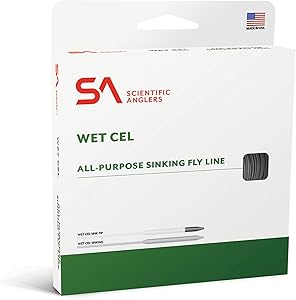
- Sink Rates: Available from Intermediate (1.25 ips) to Sink 6 (4.5 – 6.0 ips)
- Core: Braided multifilament
- Type: Full sinking fly line
- Target Application: Versatile for a variety of species and depths
The Scientific Anglers Wetcel Full Sinking Fly Line is a robust choice for fly anglers needing to get their flies down quickly and effectively. Its standout feature is the wide array of available sink rates, from a subtle Intermediate to a fast Sink 6, offering unmatched versatility for targeting different depths and species. This flexibility allows you to precisely match your line to the current conditions and the depth at which your target fish are holding, whether you’re chasing trout in deep pools or saltwater species in tidal flats.
Constructed with a durable braided multifilament core, this fly line offers a solid foundation for consistent performance and longevity. The braided core contributes to the line’s strength and helps minimize stretch, allowing for better feel and more direct hooksets. While primarily designed for fly fishing, its specialized sinking capabilities are a testament to its engineering for specific depth-oriented applications.
- Pros:
- Extremely versatile with multiple sink rates
- Effective for precise depth targeting in fly fishing
- Durable braided multifilament core
- Cons:
- Exclusively for fly fishing applications
- Choosing the correct sink rate requires knowledge
2. Lunkerhunt Sinking Braid
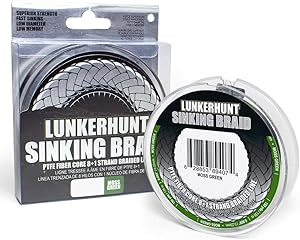
- Construction: 8+1 strand Braid PTFE Fiber Core
- Memory: Low
- Diameter: Smaller than conventional braids
- Sensitivity: Super sensitive
The Lunkerhunt Sinking Braid stands out as an excellent choice for anglers seeking a fast-sinking line that doesn’t compromise on performance. Its innovative 8+1 strand construction, featuring a PTFE fiber core, is the secret behind its rapid descent, allowing baits and lures to reach the desired depth quickly and efficiently. This advanced composition also contributes to its “super soft” feel, which translates into smoother casting and less friction through rod guides, ultimately enhancing casting distance.
Beyond its sinking and casting prowess, the Lunkerhunt Sinking Braid boasts impressive durability and sensitivity. The ultra-durable nature of the line ensures it can withstand the rigors of aggressive fish and abrasive environments, offering reliability when it matters most. Its “super sensitive” characteristic is a huge advantage, allowing anglers to detect even the subtlest bites, leading to more successful hooksets.
- Pros:
- Exceptional fast sinking ability
- Super soft and ultra-durable
- Low memory enhances casting distance
- Cons:
- Specific 8+1 strand might require adjusting knot choices
- PTFE core might feel different than standard braids
3. Beyond Braid Lead Core Trolling Line

- Construction: 8 strands PE braided fibers with an additional lead core
- Design: Multi-color, changes every 10 yards for depth gauging
- Application: Designed specifically for trolling (freshwater/saltwater)
- Strength/Length Options: 12lb-36lb, 100-yard & 200-yard spools
The Beyond Braid Lead Core Trolling Line is a purpose-built solution for anglers dedicated to effectively targeting deep-dwelling species. Its primary strength lies in its unique construction, featuring eight strands of high-quality PE braided fibers fortified with an additional lead core center. This innovative design provides the necessary weight and density to sink quickly and maintain a controlled depth, a critical factor when trolling for fish like lake trout, walleye, or striped bass that inhabit deeper parts of the water column.
A standout feature for practical application is its multi-color design, which changes hue every 10 yards. This visual cue is invaluable for anglers, offering an easy and precise method to gauge the amount of line deployed, accurately track their lure or bait position, and determine depth with precision. Whether you’re fishing in freshwater or saltwater, this line proves highly versatile for a range of trolling techniques and target species.
- Pros:
- Exceptional fast sinking for controlled depth trolling
- Multi-color design for accurate depth and line deployment
- High strength and durability with lead core
- Cons:
- Heavier and bulkier than standard braided lines
- Primarily designed for trolling, less versatile for casting
4. Daiwa X8 Sinking Yellow Braid

- Construction: X8 braid (8-strand)
- Color: High-visibility Yellow
- Length: 165 Yard Spool
- Strength: 15LB (specific to product listing example)
The Daiwa X8 Sinking Yellow Braid offers a reliable and high-performance option for anglers who prioritize both visibility and a controlled descent. As part of Daiwa’s reputable X-Braid series, this line benefits from an 8-strand construction, which results in a remarkably round, smooth, and strong braid. This advanced weaving process ensures minimal friction through rod guides, contributing to longer, more accurate casts.
The vibrant yellow color of this Daiwa braid is a significant advantage for anglers who prefer high visibility. It allows for easy line tracking above the water, helping you monitor subtle movements, detect light bites, and follow your lure’s path, which can be crucial in certain fishing techniques. Despite its bright color above water, its sinking nature still minimizes its presence where it matters most – near your bait at depth. The 165-yard spool length is suitable for many standard freshwater and light saltwater setups, providing ample line for various fishing situations.
- Pros:
- High-quality 8-strand construction for strength and smoothness
- Effective sinking properties for depth control
- High-visibility yellow color for easy line tracking
- Cons:
- Yellow color might reduce stealth in clear water
- Specific 165-yard spool length may not suit all reels
5. SeaKnight G9 II 9-Strand Fast Sinking Braid

- Construction: 9 strands (8+1) with high gravity fiber core
- Coating: Seawater-proof & UV-proof PTFE coating
- Dyeing: Water Based Patented Technology for color fastness
- Sensitivity/Stretch: High sensitivity & zero stretch
The SeaKnight G9 II 9-Strand Fast Sinking Braid is an advanced fishing line engineered for serious anglers who demand precision and durability in demanding conditions. Its core innovation lies in the “High Specific Gravity” fiber core braided technology within its 9-strand construction (8+1). This design significantly enhances the line’s sinking speed, ensuring your bait or lure reaches the target depth rapidly and stays there consistently, even in challenging currents.
Beyond its impressive sinking capability, the G9 II is built to endure. It features an updated silicon resin coating combined with a seawater-proof and UV-proof PTFE coating. This dual-layer protection not only improves heat dissipation and wear resistance but also significantly enhances casting distance and prevents fading, making it exceptionally well-suited for both freshwater and saltwater environments. The line’s high sensitivity and near-zero stretch provide immediate feedback on strikes, while its low memory contributes to longer, smoother casts and fewer wind knots.
- Pros:
- Very fast sinking due to high gravity fiber core
- Excellent seawater and UV-proof coatings for durability
- High sensitivity and near-zero stretch for strike detection
- Cons:
- 9-strand construction might be slightly thicker than 8-strand for the same test
- “High gravity fiber core” is a proprietary technology, specific performance varies
How to Choose Sinking Braided Fishing Lines
Selecting the right fishing line is as crucial as choosing the perfect lure or bait. For anglers aiming to reach specific depths, counteract strong currents, or maintain a direct connection with their presentation, sinking braided fishing lines offer a significant advantage. Unlike traditional floating braids, these specialized lines are engineered to descend quickly and efficiently, putting your bait in the strike zone faster and keeping it there. But with numerous options on the market, understanding the nuances of sinking braids is key to making the best choice for your fishing style and target species.
Understanding Sinking Braids
Sinking braided lines combine the inherent benefits of braided lines—strength, low stretch, and thin diameter—with added density that allows them to sink. This unique characteristic is achieved through various manufacturing processes, from incorporating denser materials in the core to applying specific coatings that increase specific gravity. The goal is to provide anglers with a line that cuts through the water column with minimal resistance, delivering baits precisely where they need to be.
What Makes a Braid “Sinking”?
The “sinking” property in braided lines primarily comes from two factors: material density and coatings. Some lines incorporate high-density fibers or a lead core into their construction, directly increasing the line’s weight. Others utilize special resin or PTFE coatings that make the typically buoyant PE (polyethylene) fibers heavier than water. This process results in a line that not only sinks but often does so at a controlled rate, measured in inches per second (IPS).
Advantages over Floating Braids
While floating braids excel in topwater presentations or when maximum surface visibility is desired, sinking braids offer distinct advantages for sub-surface fishing. They allow for precise depth control, keeping your lure in the strike zone longer. They also minimize wind and current drift, ensuring your presentation remains natural and your line doesn’t bow out, which significantly enhances sensitivity and direct contact with the fish. This translates to better bite detection and more effective hooksets, particularly in deeper water or strong currents.
Key Factors to Consider
Choosing the best sinking braided line involves evaluating several critical factors. Each aspect plays a role in the line’s performance, durability, and suitability for different fishing scenarios.
1. Sink Rate (IPS – Inches Per Second)
The sink rate is arguably the most important factor for a sinking braided line. Measured in IPS, it dictates how quickly your line will descend. Faster sink rates (e.g., 5-6+ IPS) are ideal for deep-water jigging, trolling, or fishing in strong currents where you need to get down fast. Slower sink rates (e.g., 1-3 IPS) are better for finesse presentations, shallow to mid-depths, or when a more subtle, controlled descent is required. Matching the sink rate to your target depth, the species you’re pursuing, and the prevailing current conditions is crucial for effective fishing.
2. Line Material and Construction
Most braided lines are made from PE fibers, but sinking versions often incorporate additional materials or specific weaves. Look for lines with an 8-strand or 9-strand construction, as these generally offer a rounder profile, smoother casting, and better knot strength compared to 4-strand braids. Some sinking braids might feature a PTFE (Teflon) coating for enhanced smoothness and faster sinking, or even a lead core for maximum weight and controlled depth, especially popular in trolling applications.
3. Pound Test (Breaking Strength)
As with any fishing line, the pound test should be matched to your tackle, the size of the fish you’re targeting, and the type of cover you’ll be fishing around. Sinking braids, due to their construction, can sometimes be slightly thicker than floating braids of the same pound test. Always check the line’s actual diameter if you’re concerned about spool capacity or casting performance. For heavy cover or large species, higher pound tests are necessary, while finesse presentations might call for lighter lines.
4. Diameter
The diameter of the line affects several aspects of fishing. A thinner diameter generally leads to longer casting distances, less wind resistance, and a faster sink rate. However, a thicker diameter can offer increased abrasion resistance and knot strength. Sinking braids often manage to maintain a relatively thin diameter while still sinking effectively, but it’s worth comparing against conventional braids. A smaller diameter also means less water resistance, which helps maintain a more direct line to your lure.
5. Abrasion Resistance and Durability
Fishing in environments with abrasive structures like rocks, timber, or shell beds requires a line with excellent abrasion resistance. Many sinking braids feature advanced coatings not only to aid in sinking but also to protect the line from wear and tear. A durable line will withstand the rigors of fishing, resist nicks and fraying, and maintain its strength over time, saving you money on frequent re-spooling.
6. Sensitivity and Stretch
One of the hallmark benefits of braided lines is their near-zero stretch, which translates to incredible sensitivity. This allows anglers to feel even the lightest bites and changes in bottom composition. Sinking braids maintain this high sensitivity, providing immediate feedback from your lure and enabling quicker, more effective hooksets. This is particularly advantageous when fishing deep, where monofilament or fluorocarbon might have too much stretch to transmit subtle information.
7. Color and Visibility
Sinking braided lines come in various colors, from high-visibility options like yellow or green to low-visibility choices like dark green, brown, or black. High-visibility lines help anglers track their line above water, which can be useful for strike detection or when guiding a lure through cover. Low-visibility lines are preferred when stealth is paramount, especially in clear water or when fish are easily spooked. Consider your typical fishing conditions and target species when choosing a color.
8. Spool Length
Sinking braided lines are available in various spool lengths, typically ranging from 100 to 300+ yards. Consider your reel’s capacity and how often you plan to re-spool. For most applications, a 150-yard spool is sufficient, but if you’re trolling or making extremely long casts, a 200 or 300-yard spool might be more appropriate.
Matching Your Line to Your Fishing Style
The “best” sinking braid is subjective and depends heavily on your specific fishing application.
Deep Water Jigging/Trolling
For deep-water jigging or trolling, especially for species like lake trout, walleye, or striped bass, a fast-sinking line with a high IPS rating or a lead core braid is ideal. These lines ensure your presentation reaches the desired depth quickly and stays there, even against strong currents. Look for lines with excellent strength and abrasion resistance to handle deep-water hazards and strong fighting fish.
Finesse Presentations
When subtlety is key, such as for finesse techniques with soft plastics or small jigs, a sinking braid with a moderate sink rate and a thin diameter is preferable. This allows for a natural presentation and maximum sensitivity to detect light bites. Consider a low-visibility color to avoid spooking cautious fish.
Heavy Cover/Saltwater
Fishing in heavy cover or demanding saltwater environments calls for a robust sinking braid with superior abrasion resistance and a higher pound test. These lines need to withstand rough structures and the immense power of saltwater species. A good coating will also help protect against the corrosive effects of saltwater and UV degradation.
Fly Fishing (Sinking Braided Cores)
While most braided lines are for spinning or baitcasting, specialized sinking fly lines exist that incorporate braided cores. These lines are designed for fly anglers to present flies at various depths, from intermediate to very fast sinking. Look for options with a range of sink rates to match different fly fishing scenarios.
Maintenance and Care Tips
Proper care can extend the life and performance of your sinking braided line.
Spooling Correctly
Always spool your braided line tightly and evenly onto your reel to prevent digging in and wind knots. Ensure you use a monofilament or fluorocarbon backing to prevent the braid from slipping on the arbor.
Checking for Damage
Regularly inspect the first few feet of your line for fraying, nicks, or discoloration. If damaged, cut off the affected section and re-tie your leader. This simple practice prevents unexpected break-offs.
Rinsing After Saltwater Use
After fishing in saltwater, rinse your reel and line thoroughly with fresh water to remove salt crystals, which can degrade the line and reel components over time.
Line Conditioners
While not always necessary for braid, some line conditioners designed for braided lines can help reduce friction, improve casting distance, and enhance overall durability.
Common Mistakes to Avoid
Even with the best sinking braid, improper use can lead to frustration.
Mismatching Sink Rate
Using a line that sinks too fast can cause your lure to snag on the bottom, while a line that sinks too slowly won’t reach your target depth. Always match the sink rate to the conditions and your technique.
Using Too Heavy/Light a Line
A line that is too heavy can hinder casting and presentation, while one that is too light risks break-offs. Balance strength with finesse for optimal results.
Ignoring Knot Strength
Braid requires specific knots that cinch down tightly without cutting itself. Practice braid-specific knots like the Palomar knot or the FG knot for leaders to ensure maximum strength.
Conclusion
Sinking braided fishing lines are invaluable tools for anglers looking to elevate their sub-surface game. By carefully considering factors such as sink rate, construction material, diameter, and abrasion resistance, you can select a line that perfectly matches your fishing style and target species. Whether you’re a fly angler seeking precise depth control or a deep-water jigging enthusiast battling strong currents, the right sinking braid will provide the sensitivity, strength, and control needed to make every fishing trip more successful and enjoyable. Invest in a quality sinking braid, and experience the difference it makes in reaching the depths where the big ones lurk.