Best Non-Smart Thermostats of 2026
While smart thermostats dominate modern technology conversations, non-smart thermostats remain a highly reliable, straightforward, and cost-effective solution for many homeowners. These traditional options eliminate the need for complex programming, Wi-Fi connections, or app setups, making them incredibly user-friendly for people of all ages. They are valued for their durability, consistent operation, and immediate control over a home’s climate system without data privacy concerns. By focusing on mechanical switches or simple digital interfaces, manual thermostats offer an efficient way to manage standard HVAC systems with minimal maintenance and zero connectivity hassles.
1. Honeywell Home The Round Manual Thermostat

- Design type: Circular manual dial
- Accuracy rate: Precise control within 1°F
- Environmental status: Completely mercury-free
- Wall protection: Decorative covering ring included
The Honeywell Home The Round Manual Thermostat brings back the classic, timeless design that millions of homeowners have trusted for decades. Its signature circular look and intuitive twist-to-adjust functionality make managing your indoor temperature completely stress-free. There are no complicated menus, schedules, or touchscreens to navigate—you simply rotate the outer ring to your preferred setting and let the unit handle the rest.
Engineered for simplicity, this non-programmable mechanical thermostat delivers highly precise control with an accuracy rating within a single degree Fahrenheit. It features a mercury-free construction that makes it safer for modern environments while retaining the vintage look. Additionally, the included decorative wall ring acts as a convenient mounting plate that neatly covers any unsightly marks or holes left behind by your previous thermostat model.
- Pros: Incredibly easy dial operation, covers old wall holes perfectly, zero programming required.
- Cons: Lacks a digital backlit display, limited to very basic system configurations.
2. Honeywell Home Heat/Cool Non-Programmable Thermostat
- Sensor type: Built-in bimetal technology
- Switch mechanism: Quick snap-action system
- System support: Standard gas or oil HVAC
- Physical footprint: 6.2W x 2.8D x 9H inches
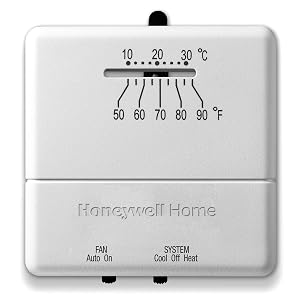
The Honeywell Home Heat/Cool Non-Programmable Thermostat offers an economical and durable solution for managing traditional home climate setups. Built with pride in the United States, this heavy-duty manual thermostat focuses strictly on essential climate controls. It bypasses all digital displays and software menus in favor of rugged mechanical levers that let you switch between heating and cooling modes instantly.
Inside the sleek beige chassis lies a highly responsive bimetal sensor paired with a reliable snap-action switch that engages your system without delay. Designed by an industry leader with over twelve decades of automation experience, this non-programmable model provides consistent climate control for standard oil or gas equipment. It is entirely mercury-free, ensuring a safe and long-lasting mechanical installation for any standard residential property.
- Pros: Highly durable physical build, simple physical slide levers, requires no electrical batteries.
- Cons: Industrial beige look may not match modern decor, mechanical sliders lack digital precision.
3. PRO1 T721 Non-Programmable Wall Thermostat

- Screen size: 4 square inch display area
- System flexibility: 2H/1C heat pump or 1H/1C conventional
- Power delivery: Dual battery or 24V hardwired
- Warranty period: 5-year commercial-grade backing
The PRO1 T721 Non-Programmable Wall Thermostat bridges the gap between traditional manual simplicity and modern visibility upgrades. It is specifically engineered to handle more complex systems, supporting up to 2 stages of heat and 1 stage of cooling for heat pumps, alongside conventional systems. The layout is optimized for straightforward everyday use with clearly marked physical buttons that require no digital scheduling knowledge.
One of its standout features is the large, high-visibility digital display complete with a bright blue backlight and glow-in-the-dark adjustment buttons. This makes checking or tweaking your home climate effortless, even in pitch-black rooms. Technicians appreciate the universal mounting sub-base and color-coded terminals, while homeowners benefit from pro features like built-in compressor protection delays and integrated filter change alerts.
- Pros: Excellent low-light visibility, multi-stage heat pump support, long five-year warranty protection.
- Cons: Interface looks more commercial than residential, digital screen requires eventual battery swaps.
4. White-Rodgers Mercury-Free Mechanical Thermostat

- Operating span: 50 to 90 degrees Fahrenheit
- Mounting package: 3-wire zone plate included
- Contact security: Fully enclosed electrical contacts
- Factory assurance: 3-year limited coverage
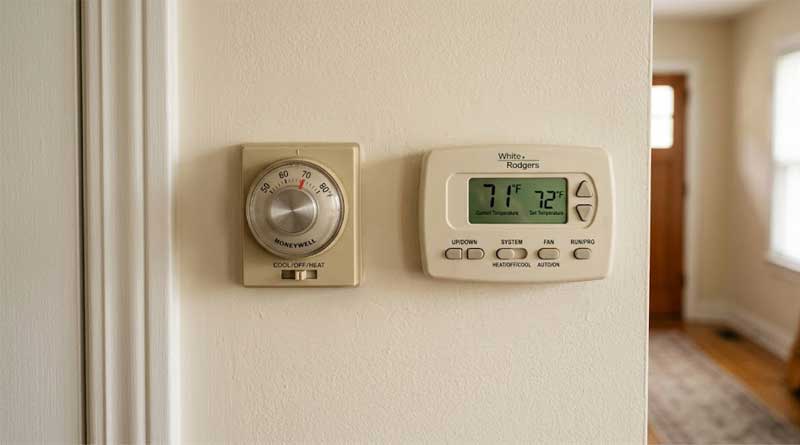
The White-Rodgers Mercury-Free Mechanical Thermostat delivers clean, classic mechanical functionality with upgraded internal components for enhanced accuracy. This universal heat and cool model relies entirely on a built-in bimetal thermometer mechanism, removing any need for electrical wiring upgrades or constant battery changes. The analog interface uses clear sliding markers along an easily readable degree scale to adjust your temperature parameters.
To maximize operational lifespan, White-Rodgers equipped this model with fully enclosed electrical contacts that prevent dust, lint, and debris buildup from degrading performance. It features dedicated switches for managing heating and cooling modes along with an automatic fan control toggle. The bundled 3-wire zone mounting plate ensures wide compatibility, providing an extremely reliable mechanical baseline for standard household utility systems.
- Pros: Enclosed contacts protect against dust, zero battery maintenance, includes clear zone plate.
- Cons: No backlight for night adjustments, analog markers can be harder to read precisely.
5. Heagstat H701 Non-Programmable Thermostat

- Screen dimensions: 4.5 square inch LCD screen
- Swing options: Adjustable from 0.2°F to 2°F
- Calibration span: -4°F to +4°F manual adjustment
- System limits: 1 Heat/1 Cool single-stage only
The Heagstat H701 Non-Programmable Thermostat provides an exceptionally clean, minimalist aesthetic combined with advanced solid-state calibration controls. Built to blend seamlessly into contemporary home interiors, this off-white digital device features a straightforward three-button interface. It provides manual control over single-stage heating and cooling systems without forcing users to contend with confusing apps, smart schedules, or wireless configurations.
The large, crisp LCD screen features a white backlight that keeps temperature numbers clearly legible under any lighting condition. Internally, the H701 boasts highly precise temperature control with an accuracy rating of plus or minus one degree. Homeowners can customize the system swing rates to protect their equipment, utilize the built-in five-minute compressor delay protection, and easily swap out batteries via the front-facing access panel.
- Pros: Crisp modern white backlighting, adjustable temperature swing rates, front-access battery door.
- Cons: Incompatible with heat pumps or multi-stage units, requires precise wiring terminal mapping.
6. White-Rodgers Emerson M30 White Heat-Only Thermostat

- Voltage support: 24V standard electrical systems
- Action process: Mechanical snap-action switch
- Application range: Heating systems only
- Mounting gear: Attractive matching wall plate
The White-Rodgers Emerson M30 White Heat-Only Thermostat focuses exclusively on delivering reliable, uncomplicated climate control for specialized heating configurations. Stripping away all extra cooling switches and programming menus, this dedicated device features a highly durable mechanical dial setup. It is designed specifically for homes that run independent furnaces or boilers and do not require combined air conditioning management.
Sporting a sleek, modern white aesthetic, the M30 looks clean and contemporary on any wall surface. It runs on a low-voltage 24V connection and utilizes a classic snap-action mechanical switch that activates your heating equipment without lag. The product comes packaged with a perfectly color-matched decorative wall plate that simplifies the DIY mounting process, making it an incredibly durable, low-profile mechanical upgrade.
- Pros: Modern and clean white casing, ultra-reliable heating control, no battery replacements needed.
- Cons: Zero support for cooling or AC equipment, missing digital temperature display.
7. Suuwer Non-Programmable Thermostat

- Wiring limits: Supports 2 to 5 wire setups
- Illumination style: Vibrant blue digital backlight
- Safety buffering: 5-minute selectable compressor delay
- Service policy: 2-year worry-free warranty window
The Suuwer Non-Programmable Thermostat is an excellent, user-friendly digital option designed specifically for standard, single-stage heating and cooling setups. The interface prioritizes high readability, featuring a prominent LCD screen illuminated by a vivid blue backlight. This digital design makes it an ideal option for elderly users or individuals who struggle to read traditional mechanical needle scales in dim lighting conditions.
Operating with an accuracy rate of plus or minus one degree, this thermostat offers comprehensive manual control alongside helpful safety configurations. Users can adjust the specific heating and cooling swing parameters anywhere from 0.2 to 2 degrees to fine-tune system cycles. Dual-power capabilities allow it to operate on batteries or hardwired power, while an integrated low-battery indicator guarantees you are never caught off guard.
- Pros: Highly legible blue backlit screen, highly granular swing adjustments, dual power delivery options.
- Cons: Will not work with central heat pump systems, DIY wiring requires strict diagram checks.
How to Choose a Non-Smart Thermostat
Selecting the right non-smart thermostat requires careful consideration of your existing heating, ventilation, and air conditioning system. Because traditional thermostats rely entirely on physical switches or specific low-voltage solid-state circuits, selecting an incompatible model can prevent your heating or cooling system from running safely. Understanding your home’s infrastructure ensures a smooth installation process and reliable year-round performance.
Understanding System Compatibility
The absolute most important step in choosing a non-smart thermostat is identifying the exact layout of your HVAC system. Traditional thermostats are strictly divided by the number of heating and cooling stages they can control, as well as the mechanical method they use to cycle your equipment. Attempting to install a single-stage manual thermostat on a complex multi-stage heat pump will result in a total loss of secondary heating capabilities.
Single-Stage vs. Multi-Stage Systems
A single-stage system operates at one steady speed, running at full capacity whenever it is turned on. Most standard non-smart thermostats, such as the Heagstat H701 or Suuwer S701, are built exclusively for these 1 Heat/1 Cool conventional configurations. Multi-stage systems, on the other hand, feature low and high operational speeds to conserve energy. If you operate a multi-stage system or a heat pump that utilizes auxiliary backup heat, you must purchase a specific multi-stage compatible model like the PRO1 T721, which explicitly handles 2 Heat/1 Cool configurations.
Heat-Only Configurations
If your property relies solely on an independent boiler, radiant baseboard system, or centralized furnace without any attached air conditioning equipment, a specialized heat-only mechanical unit is your best option. Models like the White-Rodgers Emerson M30 streamline the interface by removing cooling switches entirely. This reduces internal complexity and eliminates user errors, such as accidentally switching a system to cooling mode during cold winter months.
Mechanical vs. Digital Interfaces
Non-smart thermostats generally fall into two distinct design categories: purely mechanical models and non-programmable digital models. Both options eliminate smart phone tracking and Wi-Fi networks, but they interact with users in very different ways.
| Feature | Mechanical Thermostats | Digital Non-Smart Thermostats |
|---|---|---|
| Power Source | No batteries or C-wires needed | Requires AA/AAA batteries or 24V power |
| Display Type | Analog thermometer needle | Backlit LCD digital screen |
| Adjustments | Physical dial or sliding levers | Push-button temperature keys |
| Precision | Visual approximation on scale | Exact numerical tracking within 1°F |
Mechanical versions are prized for their complete autonomy from external power supplies. They never experience dead batteries or screen burn-in. Digital non-smart options provide far better visibility in the dark due to integrated backlights, making them much easier to read for individuals with visual impairments. Digital models also allow for granular internal adjustments, such as cycle swing rates and manual temperature sensor calibrations.
Evaluating Power Delivery and Wiring
Before buying a new manual thermostat, it is essential to remove your old wall plate and look at the wires running inside the wall. The color-coded wiring infrastructure tells you exactly what power delivery options are available for your new device.
- The Common Wire (C-Wire): Many modern digital thermostats require a dedicated C-wire to deliver continuous 24V power to run the LCD backlight. If your older home lacks a C-wire, look for a digital non-smart thermostat that features a dual-power design. Models like the Heagstat H701 can run entirely on AAA batteries, eliminating the need to fish new wires through your walls.
- Voltage Considerations: Most standard mechanical and simple digital thermostats run on 24V low-voltage control circuits. These are entirely incompatible with high-voltage, line-voltage installations (120V or 240V) commonly used for electric baseboard heaters. Connecting a standard low-voltage non-smart thermostat to a high-voltage line will immediately destroy the device and pose a severe fire hazard.
- Wire Count: Ensure your existing wiring bundle contains the right number of leads for your preferred unit. A basic heat-only setup may only need 2 or 3 wires, while a comprehensive single-stage heating and cooling unit typically requires 4 or 5 distinct wire connections to toggle the fan, compressor, and furnace effectively.
Key Operational Features to Look For
Even though non-smart thermostats lack automation, top-tier models include several built-in safety mechanisms and convenient calibration tools designed to optimize your indoor comfort and protect your equipment.
Compressor Short-Cycle Protection
When power fluctuates or someone rapidly toggles the temperature buttons up and down, an HVAC compressor can turn on and off too fast. This short-cycling places extreme mechanical stress on the compressor motor and can cause expensive system failures. Look for non-smart options that include a built-in 5-minute compressor delay protection loop. This electrical buffer forces the system to stay off for five minutes before restarting, giving internal system pressures time to safely equalize.
Adjustable Temperature Swing Rates
Every home loses heat at a different rate depending on insulation quality. High-quality digital non-smart options feature an adjustable temperature swing configuration, allowing you to set how far the room temperature can drift before the system kicks on. Setting a narrow swing rate (like 0.5°F) provides absolute temperature consistency, while widening the swing rate (up to 2°F) allows the system to run in longer, more efficient cycles, saving electricity and reducing wear on equipment.
Maintenance Indicators and Warranties
Since these devices do not send notifications to your smartphone, look for models that display maintenance icons directly on the physical hardware. Filter change indicators track system run times and display a visual reminder when it is time to slide in a clean air filter. Finally, pay attention to the manufacturer’s warranty window. Commercial-grade non-programmable options often provide longer warranties, offering peace of mind regarding the long-term reliability of your purchase.