Best Dumb Thermostats of 2026
Not every home needs a smart, app-controlled climate system. Sometimes the best thermostat is the one that just works, without Wi-Fi hiccups, firmware updates, or a learning curve. Dumb thermostats are simple, reliable, and often more affordable than their smart counterparts, making them a great choice for rentals, cabins, or anyone who prefers a straightforward dial or button. Below, we review seven of the best dumb thermostats available today, covering mechanical and basic digital models suited to different HVAC systems and budgets.
1. White-Rodgers Mercury-Free Mechanical Thermostat, 1F56N-444

System type: Universal heat/cool
Sensor: Built-in bimetal thermometer
Mounting: 3-wire zone mounting plate included
Warranty: 3-year manufacturer warranty
This White-Rodgers model is a classic mechanical thermostat built for homeowners who want dependable, no-frills temperature control. The bimetal sensor and enclosed contacts keep readings accurate over time, and the universal heat/cool compatibility makes it a fit for most standard residential systems. Installation is straightforward thanks to the included mounting plate.
Its auto-fan function and wide 50-90 degree range give it enough flexibility for year-round use. While it lacks a digital display, that simplicity is exactly the appeal for anyone replacing an aging mechanical unit without switching to digital controls.
Pros:
- Mercury-free and accurate bimetal sensor
- Simple installation with included mounting plate
- Solid 3-year warranty
Cons:
- No digital display
- Dial-based settings are less precise than digital models
2. Honeywell Home The Round Manual Thermostat, White | CT87N1001

Design: Classic circular dial
Sensor: Mercury-free
Accuracy: +/- 1 degree F
Cover: Decorative ring conceals wall marks
The Round Thermostat is one of the most recognizable dumb thermostats on the market, and for good reason. Its twist dial makes setting a temperature almost instinctive, and the mercury-free design brings an old favorite up to modern environmental standards. The decorative ring is a nice touch for anyone replacing an older, larger unit, since it hides discoloration or marks left behind on the wall.
Performance-wise, it holds temperature within one degree, which is impressive for such a basic device. It is best suited to single-stage heating and cooling systems and works well in homes, cabins, or offices where simplicity matters more than programmability.
Pros:
- Iconic, easy twist-dial operation
- Covers old wall marks with decorative ring
- Reliable +/- 1 degree accuracy
Cons:
- No backlight or digital readout
- Limited to basic single-stage systems
3. Honeywell Home Heat/Cool Non-Programmable Thermostat, Beige | CT31A1003
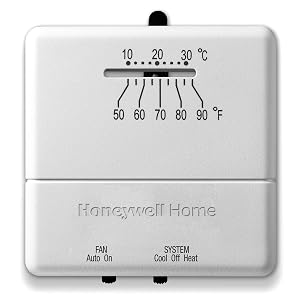
Switch type: Snap-action switch
Sensor: Mercury-free bimetal
Compatibility: Gas or oil heating and cooling equipment
Dimensions: 6.2W x 2.8D x 9H inches
This Honeywell model brings decades of manufacturing experience into a compact, no-nonsense package. The snap-action switch provides a satisfying, tactile response, and the mercury-free bimetal sensor keeps readings consistent without the environmental concerns of older units. It is a good fit for gas or oil-based heating and cooling systems that do not require staged operation.
The beige finish and standard dimensions mean it will blend into most walls without an obvious footprint of an older model. Homeowners looking for a trusted brand name with a purely manual, switch-based design will find this a dependable option.
Pros:
- Trusted Honeywell build quality
- Tactile, reliable snap-action switch
- Mercury-free sensor
Cons:
- Beige finish may not match all decor
- No display for precise readouts
4. PRO1 T721 Non-Programmable Wall Thermostat

Compatibility: 2H/1C heat pump or 1H/1C conventional
Display: Large 4 sq. in. blue backlit screen
Power: AA batteries or 24V hardwired
Warranty: 5-year warranty
The PRO1 T721 bridges the gap between purely mechanical thermostats and smart devices, offering digital convenience without any app or Wi-Fi requirement. Its large backlit display is easy to read even in dim rooms, and the glow-in-the-dark button adds a small but useful touch for nighttime adjustments. It supports both heat pump and conventional systems, which broadens its compatibility.
Configuration options like adjustable swing rates and a filter change indicator give it more functionality than most non-programmable models. Combined with a 5-year warranty, it is a strong pick for anyone wanting digital precision while keeping things simple.
Pros:
- Bright, easy-to-read backlit display
- Works with heat pump and conventional systems
- Long 5-year warranty
Cons:
- More setup options than a purely manual unit
- Battery or hardwired install still required
5. Heagstat H701 Non-Programmable Thermostat

System type: 24V conventional 1 Heat/1 Cool
Power: 24VAC or 2 AAA batteries, no C-wire needed
Accuracy: +/- 1 degree F
Warranty: 2-year warranty
The Heagstat H701 keeps things refreshingly simple with just Heat, Off, and Cool modes, making it approachable for users of any age. It is designed for single-stage conventional systems and explicitly does not support multi-stage or heat pump setups, so compatibility should be confirmed before purchase. The dual power design means it can run without a common wire in most installations.
The 4.5 sq inch backlit display is easy to read, and the compact footprint makes it simple to mount in tight spaces. For straightforward single-stage homes, it offers reliable performance at a low price point.
Pros:
- No common wire required in most setups
- Clear backlit display
- Simple Heat/Off/Cool operation
Cons:
- Not compatible with multi-stage or heat pump systems
- Shorter 2-year warranty than some competitors
6. White-Rodgers Emerson M30 White Heat-Only Thermostat

System type: Heat-only
Switch type: Standard mechanical snap action
Voltage: 24V
Design: Sleek, modern wall plate
For homes that only need heating control, the White-Rodgers Emerson M30 delivers a purpose-built, mechanical solution. The 24V snap-action switch is a tried-and-true design that has powered heating systems reliably for years, and the modern wall plate keeps the aesthetic clean despite the purely mechanical internals.
This thermostat is best suited to older or simpler heating-only systems where cooling control is not needed. Its straightforward operation means there is little to learn or troubleshoot, and the attractive wall plate helps it look at home in most rooms.
Pros:
- Simple, reliable heat-only operation
- Attractive, modern wall plate design
- Durable mechanical snap-action switch
Cons:
- No cooling functionality
- No digital display or backlight
7. Suuwer Non-Programmable Thermostat, Blue Backlight

System type: 1 Heat/1 Cool conventional single-stage
Power: 24VAC or 2 AAA batteries, no C-wire needed
Accuracy: +/- 1 degree F
Warranty: 2-year warranty
The Suuwer S701 is a budget-friendly digital thermostat aimed at single-stage conventional systems. Its blue backlit display is large and easy to read, which the manufacturer notes is especially helpful for older users. Dual power options mean it can be installed with or without a common wire, simplifying setup for many homes.
Adjustable swing settings and a five-minute compressor delay add a layer of protection and customization not always found at this price point. As with similar models, it is not compatible with multi-stage or heat pump systems, so checking existing wiring beforehand is essential.
Pros:
- Large, easy-to-read blue backlit display
- No common wire required in most cases
- Affordable price point
Cons:
- Limited to single-stage conventional systems
- 2-year warranty is shorter than premium options
How to Choose the Right Dumb Thermostat
Choosing a dumb thermostat might seem simple compared to picking a smart, app-connected model, but there are still several important factors to weigh. Because these thermostats lack the flexibility of software updates or remote diagnostics, getting the right match for your HVAC system and household needs is essential from the start. Below is a breakdown of the key considerations to help you choose confidently.
Understand Your HVAC System Type
The single most important factor in choosing a dumb thermostat is compatibility with your existing heating and cooling system. Unlike smart thermostats, which often include broader compatibility checkers or app-based diagnostics, basic thermostats require you to know your system’s specifications ahead of time.
Conventional Systems
Conventional single-stage systems are the most common setup in older homes and are supported by nearly all the thermostats reviewed above, including the Heagstat H701 and Suuwer S701. These systems typically use a standard set of wires labeled R, W, Y, G, and sometimes C.
Heat Pump Systems
Heat pump systems, especially multi-stage ones, require more careful attention. The PRO1 T721 is the only model in this list built to support 2H/1C heat pump configurations. If your home uses a heat pump, always confirm the staging requirements before purchasing, since many basic thermostats explicitly exclude heat pump compatibility.
Heat-Only or Cool-Only Systems
Some households, particularly those with separate cooling solutions like window units, only need heating control. The White-Rodgers Emerson M30 is designed specifically for heat-only setups, offering a simpler and often more affordable option than universal heat/cool models.
Wiring and Power Requirements
Before buying, check how many wires your current thermostat uses and whether a common wire (C-wire) is present. Many basic thermostats, including the Heagstat H701 and Suuwer S701, are designed to work without a C-wire by running on batteries instead, which makes them useful in older homes where rewiring is inconvenient or costly.
| Power Option | Pros | Cons |
|---|---|---|
| 24VAC Hardwired | No batteries to replace, consistent power | Requires compatible wiring, harder to relocate |
| Battery Powered | Easy installation, no C-wire needed | Batteries need periodic replacement |
| Dual Power (Both) | Flexible installation options | Slightly higher upfront cost |
Mechanical vs Digital Displays
Dumb thermostats generally fall into two categories: mechanical dial-based units and basic digital models. Each has distinct advantages depending on your priorities.
Mechanical Thermostats
Mechanical thermostats, such as the White-Rodgers 1F56N-444 and the Honeywell Round CT87N1001, use a bimetal sensor and a dial or lever to set the desired temperature. These units are prized for their durability and simplicity, often lasting decades with minimal maintenance. They do not require batteries in many cases and have no digital components to fail.
Basic Digital Thermostats
Digital non-programmable thermostats, like the PRO1 T721 and Suuwer S701, offer a clear numeric readout and often a backlight for visibility in low light. While they still lack programming schedules, they tend to offer more precise temperature control and additional features like compressor delay protection.
Temperature Accuracy and Control Range
Accuracy matters even in the simplest thermostats. Most models reviewed here offer accuracy within one degree Fahrenheit, which is generally sufficient for everyday comfort. Pay attention to the stated control range as well; some models, such as the Heagstat H701, have a control range of 44 to 90 degrees Fahrenheit, which should comfortably cover most climates but may be worth checking against your local extremes.
Special Features Worth Considering
Even within the category of dumb thermostats, a few extra features can make daily use more convenient.
- Backlit displays for visibility in dim rooms
- Filter change indicators to remind you of HVAC maintenance
- Compressor delay protection to extend equipment lifespan
- Decorative wall plates to cover marks from a previous thermostat
- Adjustable temperature swing settings for finer control over cycling
Warranty and Durability
Warranty length can be a useful indicator of a manufacturer’s confidence in a product. Among the models reviewed, warranties range from two years, as seen with the Heagstat H701 and Suuwer S701, up to five years for the PRO1 T721. Mechanical thermostats often last well beyond their warranty period due to their simple construction, but a longer warranty still provides peace of mind, especially for digital models with more components that could fail.
Installation Considerations
Most dumb thermostats are designed for straightforward DIY installation, but a few points are worth checking beforehand.
| Consideration | Why It Matters |
|---|---|
| Wire count and labeling | Ensures compatibility with the new thermostat’s terminals |
| Mounting plate size | Affects whether it covers marks from an old thermostat |
| Wire gauge | Most units require 18-22 gauge thermostat wire |
| Existing base compatibility | Some models require verifying wire count before purchase |
If you are unfamiliar with HVAC wiring, it is worth taking a photo of your existing thermostat’s wiring before removing it, and comparing it against the new thermostat’s installation guide. Several manufacturers, including Heagstat and Suuwer, note that shielded wire is not required, which simplifies most residential installations.
Matching the Thermostat to Your Household
Finally, consider who will be using the thermostat daily. Larger, backlit displays are helpful for households with older family members or anyone who prefers clear, easy-to-read numbers. Mechanical dial thermostats, while simple, may be preferable for households that want the most minimal design possible with no digital components at all. Weighing these day-to-day usability factors alongside technical compatibility will help you land on the dumb thermostat that best fits your home.