Best Fixed-Mount VHF Marine Radios of 2026
Choosing the right fixed-mount VHF marine radio can make the difference between a routine day on the water and a genuine emergency response. These radios offer higher power output, better range, and more reliable DSC distress communication than handheld units, making them essential for serious boaters. This guide reviews five popular marine VHF radios, covering their key features, strengths, and weaknesses, and closes with a detailed buying guide to help you choose the right radio for your boat, budget, and boating style.
1. Retevis RA27 Fixed Mount Marine VHF Radio

Power Output: 25W transmission power
Waterproofing: IP67 waterproof and floating design
Navigation: Built-in GPS with DSC distress calling
Display: Dot matrix LCD screen with NOAA weather alerts
The Retevis RA27 stands out for boaters who want integrated GPS navigation alongside dependable ship-to-shore communication. Its built-in GPS connects with compatible chartplotters and enables one-button DSC distress alerts that transmit your exact coordinates to nearby vessels and the coast guard. The dot matrix LCD screen keeps operation straightforward even in stressful situations.
Its compact housing allows flush or bracket mounting, saving valuable helm space on smaller boats. The IP67 rating and floating capability add peace of mind in rough marine conditions. With triple watch and support for USA, Canada, and international channels, it suits offshore cruisers seeking an all-in-one navigation and communication solution.
Pros:
- Built-in GPS for accurate DSC positioning
- Space-saving flush or bracket mount design
- IP67 waterproof and floats if dropped
Cons:
- Smaller screen compared to premium models
- Menu navigation may feel less intuitive to new users
2. Uniden UM385 25 Watt Fixed Mount Marine VHF Radio
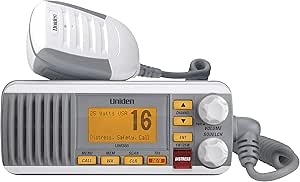
Power Output: 25 watts of transmission power
Waterproofing: IPX4 rated against rain and splashing
Safety Features: Full Class D DSC with distress button
Weather Alerts: S.A.M.E. weather alert system
The Uniden UM385 is a trusted, no-frills fixed-mount radio built for reliability. Its rugged handheld mic lets you transmit while keeping your eyes on the water, and the triple watch feature helps monitor multiple channels simultaneously. Full Class D DSC capability, including a distress button with position send and request, ensures rapid emergency response when it matters most.
The S.A.M.E. weather alert system delivers localized storm warnings before conditions worsen, a valuable safety feature for coastal and offshore boaters alike. While its IPX4 rating is lower than some waterproof-rated competitors, the UM385 compensates with a high-performance transceiver delivering clear transmission and strong customer support backing from Uniden.
Pros:
- Reliable Class D DSC with distress calling
- S.A.M.E. weather alert for localized storm warnings
- Strong brand reputation and customer support
Cons:
- IPX4 rating offers less water resistance
- No built-in GPS receiver
3. Cobra BlueBound 350 VHF Handheld Marine Radio

Power Output: Switchable 1/3/6 watts
Waterproofing: IPX7 rated, suitable for immersion
Display: Day/Night selectable LCD screen
Channel Monitoring: Tri-Watch mode for channels 9, 16, and custom
The Cobra BlueBound 350 brings flexibility to boaters who want adjustable power settings for different range and battery needs. Its high-visibility orange floating core makes retrieval easy if the radio goes overboard, while the switchable wattage lets users optimize battery life during shorter trips or extend range when needed offshore.
Tri-Watch mode is a standout feature, letting users monitor channels 9 and 16 alongside a custom channel simultaneously, ideal for busy waterways. The day/night display improves visibility in changing light conditions, and access to 12 NOAA weather channels keeps boaters informed. Its portability makes it a strong secondary radio alongside a fixed-mount unit.
Pros:
- Adjustable power output for flexible use
- Highly visible floating design aids retrieval
- Tri-Watch mode monitors three channels at once
Cons:
- Lower maximum power than fixed-mount units
- Best suited as a backup, not primary radio
4. Retevis RM21 Floating Marine Radio

Power Output: Switchable 5W/3W/1W settings
Waterproofing: IP67 waterproof with floating alert light
Battery Life: 1800mAh battery, 10 hours operation
Audio: AI intelligent noise cancellation
The Retevis RM21 focuses on clarity and endurance, using AI-powered noise cancellation to reduce engine, wind, and wave interference during transmission. Its one-button noise cancellation and monitoring controls make it especially easy to operate for kayakers, sailors, and offshore anglers who need quick, simple access to communication features while managing other tasks.
A standout safety feature is its floating design with a red flashing light that activates automatically when submerged, helping users locate the radio quickly in water. The high-capacity 1800mAh battery delivers a full day of use, and instant access to channel 16 plus NOAA weather alerts rounds out a solid feature set for smaller vessels and watersport enthusiasts.
Pros:
- AI noise cancellation improves voice clarity
- Automatic flashing light aids recovery if dropped
- Long battery life for all-day trips
Cons:
- Lower maximum power than fixed-mount radios
- Best for smaller boats, kayaks, and short trips
5. Uniden Atlantis 275 Handheld Two-Way VHF Marine Radio

Power Output: 6 watts, selectable 6W/2.5W/1W
Waterproofing: IPX8/JIS8 rated, fully submersible
Display: Large LCD with day and night backlight
Extras: Built-in flashlight and emergency strobe light
The Uniden Atlantis 275 packs impressive capability into a pocket-sized radio, featuring the largest LCD screen in its class along with a paper-white day display and red night backlight for easy reading in any condition. Its 6-watt power output, with selectable settings, gives boaters flexibility between range and battery conservation.
Built to survive full submersion and even clear its own speaker afterward, the Atlantis 275 is one of the most rugged handhelds available. The included strobe light and flashlight add extra utility during nighttime emergencies, while the three-year waterproof warranty reflects strong manufacturer confidence. It’s an excellent backup or dinghy radio.
Pros:
- Exceptional IPX8/JIS8 waterproofing and submersion recovery
- Large, easy-to-read day and night display
- Includes flashlight and emergency strobe
Cons:
- Handheld design limits range versus fixed-mount units
- Not a replacement for a primary station radio
How To Choose Fixed-Mount VHF Marine Radio
Selecting the right VHF marine radio is one of the most important safety decisions a boater can make. Unlike handheld units, fixed-mount radios are permanently installed at the helm, drawing power directly from the boat’s electrical system and connecting to an external antenna for maximum range and transmission strength. Because this is a long-term investment tied to your vessel’s safety systems, it pays to understand the key factors that separate a good radio from a great one.
Understanding Power Output
Fixed-mount VHF radios typically transmit at 25 watts, the maximum power allowed for marine VHF communication in most regions, while handheld units are limited to around 5-6 watts. Higher wattage translates directly into greater transmission range, which is critical during emergencies or when communicating with distant vessels and coast guard stations.
Most fixed-mount radios also allow switching down to 1 watt for close-range communication, such as talking to a nearby vessel or marina, which helps reduce channel congestion and conserve power. When comparing radios, always check whether full 25-watt output is standard or requires an upgraded model.
DSC and GPS Integration
Digital Selective Calling, or DSC, is one of the most important safety features in modern VHF radios. It allows you to send an automated distress signal with a single button press, transmitting your vessel’s identity and, if connected to GPS, exact location to the coast guard and nearby boats instantly.
Built-In vs External GPS
Some radios, like the Retevis RA27, include built-in GPS receivers, eliminating the need for external wiring. Others require connection to an external GPS antenna or chartplotter to enable full DSC positioning functionality. If your boat doesn’t already have a GPS source, a radio with integrated GPS simplifies installation and ensures your distress calls always include accurate coordinates.
Class D DSC Compliance
Look for radios offering Class D DSC compliance, which means the radio continuously monitors channel 70 for distress calls in the background while you use other channels normally. This ensures you never miss an emergency broadcast from another vessel, even while engaged in routine conversation.
Waterproofing And Durability Ratings
Marine environments expose electronics to rain, spray, humidity, and occasional submersion, making waterproof ratings a critical consideration. Ratings follow the IP (Ingress Protection) or JIS (Japanese Industrial Standard) scale, and understanding these numbers helps you match a radio to your boating conditions.
| Rating | Protection Level | Best Suited For |
|---|---|---|
| IPX4 | Splash and rain resistant | Calm inland or coastal boating |
| IP67 | Withstands temporary immersion | Open water and rough conditions |
| IPX7 | Immersion up to 1 meter | Offshore fishing and sailing |
| IPX8/JIS8 | Full submersion, speaker self-clears | Extreme conditions and backup use |
For a helm-mounted radio protected under a console or bimini, IPX4 or IP67 may be sufficient. However, boaters facing frequent spray, rain, or rough seas should prioritize IP67 or higher for long-term reliability.
Display And Ease Of Use
A clear, readable display matters more than it may seem, especially during nighttime navigation or emergencies when quick channel changes are necessary. Look for radios offering both day and night display modes, adjustable backlighting, and large, high-contrast screens that remain legible in direct sunlight.
Button layout and menu simplicity also matter under stress. Radios with dedicated distress buttons, one-touch channel 16 access, and intuitive tri-watch or dual-watch controls reduce the chance of user error during critical moments.
Weather Alerts And Additional Features
NOAA weather alert functionality is a near-universal feature among modern VHF radios, but the quality of implementation varies. Some radios offer S.A.M.E. (Specific Area Message Encoding) alerts, which filter warnings to your specific location rather than broadcasting alerts for an entire region, reducing unnecessary interruptions.
Other valuable features to consider include:
- Triple or tri-watch monitoring for tracking multiple channels simultaneously
- Noise cancellation technology for clearer audio in windy or loud conditions
- External speaker compatibility for larger vessels or noisy helm stations
- Compact or flush-mount designs for boats with limited helm space
- Backup handheld radios for dinghies, tenders, or emergency use
Installation And Mounting Considerations
Before purchasing, measure your available helm space and decide between flush mounting, which creates a clean, integrated look, or bracket mounting, which allows easier removal and antenna adjustment. Confirm the radio’s physical dimensions match your available space, and check that mounting hardware and wiring harnesses are included.
Also consider antenna compatibility. Fixed-mount radios require a separate marine VHF antenna, so verify connector types and cable lengths match your existing setup or budget for a compatible replacement.
Matching The Radio To Your Boating Style
Your ideal radio depends heavily on how and where you boat. Coastal day-trippers may prioritize ease of use and basic DSC functionality, while offshore anglers and long-distance cruisers should prioritize maximum range, robust waterproofing, and integrated GPS for reliable emergency positioning.
Consider these general guidelines when narrowing your choice:
- Coastal and inland boating: 25W fixed-mount radio with basic DSC and IPX4-IP67 rating
- Offshore fishing and cruising: Built-in GPS, Class D DSC, and IP67 or higher waterproofing
- Backup or secondary radio: Compact handheld with high waterproof rating and floating design
- Budget-conscious buyers: Reliable 25W radio with core DSC and weather alert features
Final Thoughts
Ultimately, the best fixed-mount VHF marine radio balances power, reliability, waterproofing, and ease of use to match your specific boating needs. Prioritizing DSC functionality and GPS integration ensures you’re prepared for emergencies, while durability ratings and display quality improve everyday usability. Taking time to match these features to your vessel and boating habits will result in a radio you can depend on for years of safe navigation.