Best VHF Radios for Boats of 2026
Selecting the right marine VHF radio is one of the most critical safety decisions you will make for your vessel. Whether you are navigating inland lakes or venturing far offshore, these communication devices serve as your lifeline during emergencies and your primary means of contacting nearby vessels or harbor masters. Modern options combine powerful transceivers, global positioning systems, and rugged waterproof construction. In this guide, we evaluate the top marine radios available today to help you find the perfect match.
1. Retevis RA27 Fixed Mount Marine VHF Radio

- Radio Type: Fixed Mount
- Transmit Power: 25 Watts
- Waterproof Rating: IP67
- GPS Capability: Built-in GPS receiver
The Retevis RA27 is a highly capable fixed-mount marine transceiver that prioritizes vessel safety and navigation. Featuring an integrated GPS receiver, this radio simplifies the setup process by eliminating the need to splice wires into an external chartplotter to enable basic Digital Selective Calling capabilities. The high-contrast dot matrix LCD screen is easy to read in direct sunlight, displaying essential data during emergency situations.
Its space-saving chassis fits nicely into crowded helms using either a bracket or flush mount. We appreciate the multi-button microphone, which allows operators to control volume and channels directly without leaning over the console constantly.
Pros:
- Integrated GPS saves setup time
- Excellent IP67 waterproofing protection
- Convenient multi-button speaker mic
Cons:
- Requires permanent 12V installation
- Menu interface takes time to master
2. Uniden UM385 25 Watt Fixed Mount Marine VHF Radio
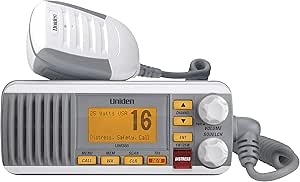
- Radio Type: Fixed Mount
- Transmit Power: 25 Watts
- Waterproof Rating: IPX4 splashproof
- Emergency Alert: S.A.M.E. Weather Alert
The Uniden UM385 is an extremely reliable fixed-mount marine radio designed to keep boaters fully informed and connected. It features full Class D DSC functionality with a dedicated distress button to instantly transmit your position in emergencies. The inclusion of S.A.M.E. weather alerts ensures you receive localized storm warnings before hazardous conditions arrive.
Its rugged microphone is built for heavy hands, delivering crisp, clear voice transmission even when engine noise is high. This unit acts as an excellent, budget-friendly defense system that is incredibly easy to install on smaller center consoles.
Pros:
- Loud and clear audio output
- Comprehensive localized weather warnings
- Durable and compact housing design
Cons:
- IPX4 rating only resists splashes
- Requires external GPS connection for DSC functions
3. Cobra BlueBound 350 VHF Handheld Marine Radio

- Radio Type: Handheld Portable
- Transmit Power: 6 Watts (Switchable 1/3/6W)
- Waterproof Rating: IPX7 submersible
- Visual Feature: Orange floating core
The Cobra BlueBound 350 offers an outstanding balance of portability, power, and rugged reliability for nearshore and inland boaters. With its signature bright orange core, this handheld transceiver is engineered to float facing upward if dropped over the side, making retrieval painless. The selectable power output allows users to preserve battery life when communicating with nearby vessels by switching down to lower wattages.
Its day and night screen modes make reading channel settings easy under any ambient lighting condition. The dedicated tri-watch feature is great for monitoring critical safety frequencies while staying tuned to your crew’s preferred channel.
Pros:
- Highly visible floating chassis design
- Power adjustment options maximize battery
- Submersible waterproof protection
Cons:
- Shorter range than fixed-mount units
- Battery drains faster at maximum power
4. Retevis RM21 Floating Marine Radio

- Radio Type: Handheld Portable
- Transmit Power: 5 Watts (Switchable 5/3/1W)
- Waterproof Rating: IP67 waterproof
- Noise Cancellation: AI intelligent filtering
The Retevis RM21 stands out for its advanced audio technology, incorporating AI intelligent noise cancellation to strip away unwanted marine sounds. It filters out howling winds, roaring engines, and rushing waves so your voice transmits with perfect clarity. This handheld unit is perfectly suited for kayak anglers, active sailboat crews, and anyone operating open-deck vessels.
Equipped with a water sensor, the radio flashes a bright red light when submerged to guarantee quick recovery during night operations. The long-lasting lithium-ion battery provides up to ten hours of continuous operation, ensuring you stay connected all day without needing a recharge.
Pros:
- Exceptional AI background noise cancellation
- Flashing red sensor aids water retrieval
- Generous battery operating life
Cons:
- Maximum 5W output is slightly lower
- Charging cradle is somewhat bulky
5. Uniden Atlantis 275 Handheld Two-Way VHF Marine Radio

- Radio Type: Handheld Portable
- Transmit Power: 6 Watts (Switchable 6/2.5/1W)
- Waterproof Rating: IPX8 / JIS8 submersible
- Screen Size: Largest in class LCD
The Uniden Atlantis 275 is a premium handheld VHF radio packed with safety innovations, including an integrated emergency strobe light. It boasts the largest screen in its class, complete with dual-color backlighting to optimize readability during both midday sun and pitch-black nights. The unit meets strict IPX8 waterproof standards, handling complete submersion without skipping a beat.
A unique vibrating feature clears water from the speaker grille after a dunk, ensuring clear incoming audio is instantly restored. Backed by a generous three-year warranty, this handheld offers unmatched peace of mind for serious blue-water mariners.
Pros:
- Superior IPX8 submersible rating
- Built-in emergency strobe and flashlight
- Vibrating speaker water clearance
Cons:
- More expensive than basic handhelds
- Slightly wider profile in hand
Choosing the Perfect Marine VHF Radio for Your Vessel
Selecting the right marine VHF radio requires an understanding of your typical boating environment, safety protocols, and the physical constraints of your vessel. Marine communication is not just about casual chatting; it is your ultimate lifesaver when things go wrong on the water. To make an informed purchase, you must evaluate several critical technical elements. This comprehensive guide will walk you through everything from installation types to emergency broadcast features, ensuring you choose a radio that keeps you connected under any circumstances.
Fixed Mount vs. Handheld Radios
The first major decision you must make is whether to purchase a fixed-mount radio or a portable handheld unit. Both options have distinct advantages, and many experienced offshore boaters actually carry both to ensure they have a redundant system in place. Fixed-mount radios are permanently installed into the boat console and wired directly into the main battery system. This configuration guarantees a steady power supply and maximum transmission capabilities, making them the standard choice for larger vessels.
Handheld radios, on the other hand, offer unmatched portability and independence from the vessel electrical grid. If your boat capsizes or suffers complete power failure, a handheld unit remains fully operational in your pocket. These compact devices are ideal for smaller boats like kayaks, dinghies, or personal watercraft where helm space is nonexistent. The table below illustrates the core operational differences between these two common formats.
| Feature | Fixed Mount Radios | Handheld Radios |
|---|---|---|
| Maximum Transmit Power | Up to 25 Watts | Up to 6 Watts |
| Typical Communication Range | 15 to 25 miles | 3 to 8 miles |
| Primary Power Source | 12-Volt onboard battery system | Rechargeable lithium-ion battery pack |
| Portability and Mobility | Stationary at the helm console | Highly portable, can be worn on life jacket |
| Emergency Independence | Fails if main boat power is lost | Operates independently of boat power |
Understanding Power Output and Communication Range
The distance over which you can communicate is directly tied to the power output of your radio and the height of your antenna. Marine VHF radios operate on a line-of-sight principle, meaning the radio waves travel in a straight line and do not follow the curvature of the earth. Therefore, physical obstructions and antenna elevation play a massive role in signal performance.
The Power Advantage of Fixed Units
Fixed-mount radios operate at twenty-five watts of power, which is the legal maximum limit for recreational marine transceivers. This high wattage allows the signal to punch through atmospheric interference, heavy rain, and light structural blockages. It ensures that your distress calls can reach distant Coast Guard stations or offshore vessels that are miles away from your location.
Battery Optimization in Handhelds
Handheld radios operate at much lower wattages, typically topping out at five or six watts to prevent excessive battery drain and thermal issues. Most quality handheld models feature switchable power modes, allowing you to select between one, three, or six watts. Using the lowest possible wattage for close-range communications helps conserve precious battery life for when you genuinely need maximum reach.
The Crucial Role of Antenna Height
Because VHF signals rely on line-of-sight, a twenty-five-watt radio with a low-mounted antenna may perform worse than a six-watt handheld held high above the deck. For fixed installations, investing in a high-quality, tall fiberglass antenna is just as important as the radio itself. Mounting your antenna on a sailboat mast or a T-top arch vastly increases your communication horizon, extending your safety reach exponentially.
Waterproofing Standards Explained
The marine environment is incredibly harsh, characterized by corrosive saltwater, heavy rain, and constant humidity. When choosing a radio, pay close attention to the International Protection rating. These standards tell you exactly how much water exposure your device can handle before failing.
- IPX4: Resistant to splashing water from any direction, suitable for fully enclosed cabins only.
- IPX7: Can survive complete submersion in water up to one meter deep for thirty minutes, ideal for open consoles.
- IPX8: Fully submersible beyond one meter for extended periods, providing maximum protection against sinking.
Digital Selective Calling and GPS Integration
Digital Selective Calling is a standardized service that allows mariners to instantly send automated distress signals to rescue authorities and surrounding vessels. When you press the red distress button, the radio transmits a digital burst containing your unique identification number, bringing immediate attention to your situation.
The Necessity of GPS Data
For Digital Selective Calling to be truly effective, the radio must know exactly where you are. Advanced VHF models feature integrated GPS receivers that continuously track your coordinates. If your radio does not have built-in GPS, you must manually connect it to your onboard chartplotter via a wiring harness. Choosing a radio with built-in GPS simplifies installation and guarantees that rescue teams receive your precise location coordinates automatically during an emergency.
Essential Secondary Features for Boating Safety
Beyond raw power and waterproofing, several modern features can greatly improve your overall user experience and safety on the water. When comparing different models, consider how these additions align with your specific boating habits.
Active Noise Cancellation
Operating an open motorboat can be extremely noisy due to rushing wind, splashing waves, and roaring engines. Radios equipped with artificial intelligence noise-filtering technology actively remove these background noises from your transmission. This ensures that the person on the receiving end hears a clear human voice rather than a wall of static and engine hum.
Floatation and Flashing Sensors
If a handheld radio slips out of your hand and sinks into the ocean depths, it is of no use to you. Many modern handheld models are specifically engineered with hollow cores or buoyant materials that force them to float. Furthermore, some units feature water-activated flashing lights or bright strobe systems that turn on automatically when wet, allowing you to easily spot and retrieve the floating device at night.
Weather Alert Access
Sudden storms can turn a peaceful day on the water into a survival situation. Marine radios feature dedicated access to National Oceanic and Atmospheric Administration weather channels. Advanced models include automated weather alerts that interrupt normal radio scanning to broadcast warning tones when severe weather conditions threaten your local coordinates.
Making Your Final Decision
Ultimately, the best marine VHF radio is the one that fits your navigation habits and vessel configuration perfectly. For offshore fishing and long-distance cruising, a high-power fixed-mount unit with built-in GPS is an absolute necessity. For kayakers, nearshore sailors, or as a backup device, a floating, waterproof handheld radio offers the flexibility and safety you need to enjoy your time on the water with complete peace of mind.